
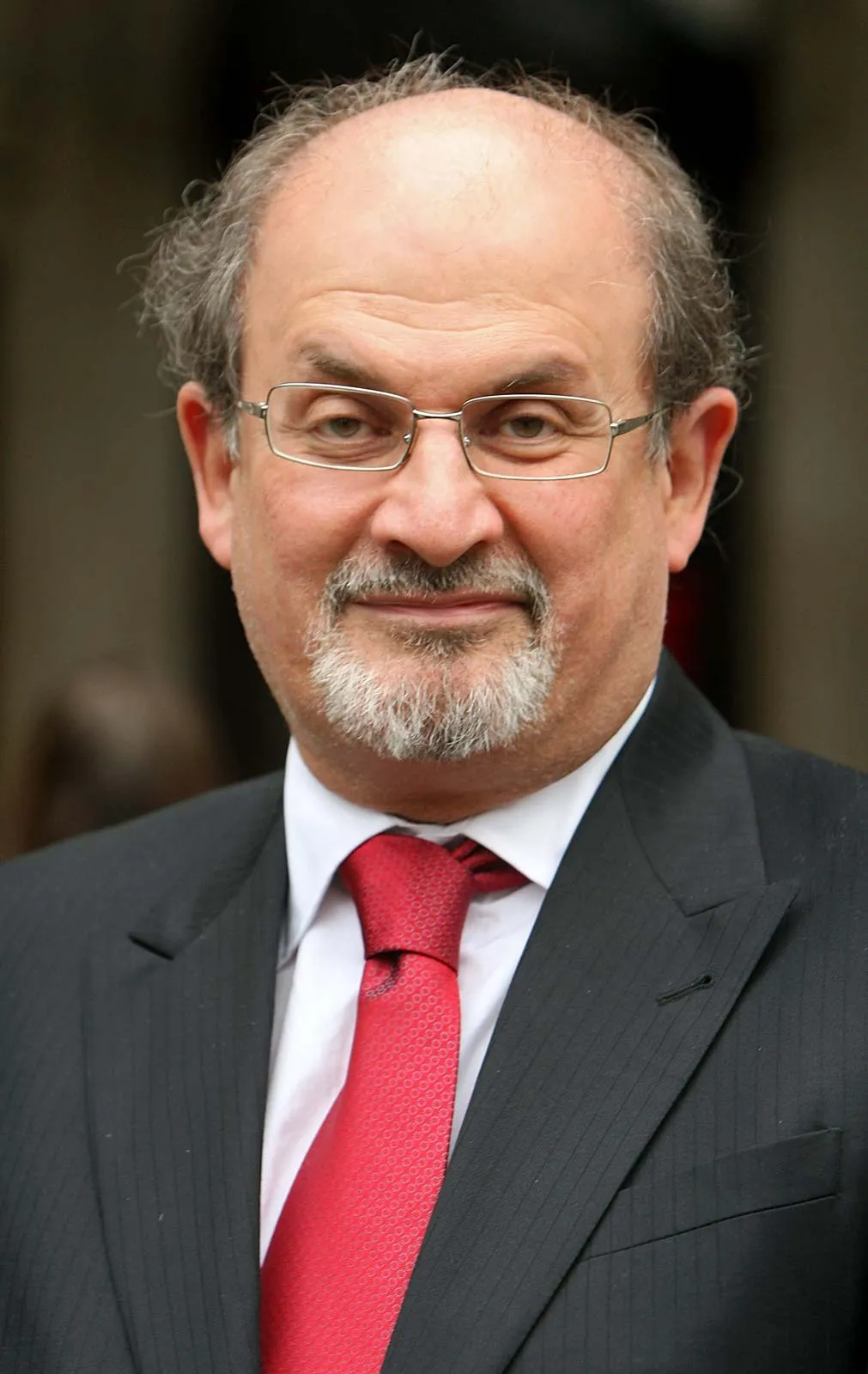
Salman Rushdie, born on June 19, 1947, in Bombay, India, is one of the most influential and controversial authors of the late 20th and early 21st centuries. Known for his masterful storytelling and rich, imaginative narratives, Rushdie’s work often explores the complex interplay between history, culture, and religion. However, his fame is inextricably linked to the controversy surrounding his novel The Satanic Verses, which led to a fatwa being issued against him by Iran’s Ayatollah Khomeini in 1989. This article provides a detailed exploration of Rushdie’s life, his literary achievements, and the historical context that has shaped his enduring legacy.
Early Life and Education
Salman Rushdie was born into a Muslim family of Kashmiri descent in Bombay, India, just two months before the country gained its independence from British rule. His father, a successful businessman, and his mother, a teacher, provided a comfortable and intellectually stimulating environment. At the age of 14, Rushdie was sent to England to attend the prestigious Rugby School, an experience that exposed him to Western culture and literature.
After completing his secondary education, Rushdie attended King’s College, Cambridge, where he studied history. His time at Cambridge was pivotal in shaping his literary voice, blending his rich cultural heritage with the Western literary canon. It was during these years that Rushdie began to cultivate his distinctive style, characterized by magical realism and a deep engagement with historical and political themes.
Literary Beginnings
Rushdie’s literary career began modestly with the publication of Grimus in 1975, a science fiction novel that received little critical attention. However, it was his second novel, Midnight’s Children (1981), that catapulted him to international fame. The novel, which tells the story of India’s transition from British colonialism to independence through the life of its protagonist, Saleem Sinai, was a groundbreaking work that blended historical events with magical realism. Midnight’s Children won the Booker Prize in 1981 and was later awarded the Booker of Bookers in 1993 and 2008, cementing its status as one of the greatest English-language novels of the 20th century.
The Satanic Verses and Global Controversy
In 1988, Rushdie published The Satanic Verses, a novel that would forever change his life. The book, which explores themes of religious faith, doubt, and identity, includes a fictionalized retelling of the life of the Prophet Muhammad. Although Rushdie intended the novel to be a meditation on the nature of religious belief, many Muslims viewed it as blasphemous. The most controversial aspect was its portrayal of the Prophet Muhammad, which some interpreted as disrespectful.
The reaction to The Satanic Verses was swift and severe. Protests erupted across the Muslim world, with the book being banned in several countries. The controversy reached its peak on February 14, 1989, when Iran’s Supreme Leader, Ayatollah Khomeini, issued a fatwa calling for Rushdie’s assassination. This edict forced Rushdie into hiding for nearly a decade, during which he lived under constant police protection.
The fatwa had a profound impact on Rushdie’s life and career. While he continued to write and publish, the threat of violence loomed large over his personal and professional life. The fatwa also sparked a global debate about freedom of speech, censorship, and the power of religious authority in the modern world. Despite the danger, Rushdie remained defiant, refusing to renounce the novel or apologize for its content. Over time, the international literary community rallied around him, recognizing the fatwa as an egregious violation of free expression.
Life in Hiding and Literary Perseverance
During the years he spent in hiding, Rushdie adopted the pseudonym “Joseph Anton,” a name he later used as the title of his 2012 memoir. Joseph Anton: A Memoir provides an intimate account of his life under the fatwa, detailing the psychological and emotional toll it took on him, as well as his determination to continue writing despite the threats against his life.
Even while in hiding, Rushdie remained prolific. In 1990, he published Haroun and the Sea of Stories, a novel for children that, while lighter in tone, still grappled with themes of storytelling, freedom, and the battle between good and evil. This book was a departure from the more politically charged works of his earlier career, but it was widely acclaimed and demonstrated Rushdie’s versatility as a writer.
The 1990s saw Rushdie continue to produce significant works, including The Moor’s Last Sigh (1995) and The Ground Beneath Her Feet (1999), both of which received critical acclaim. These novels, like his earlier work, explored the intersections of history, culture, and personal identity, using a blend of realism and fantastical elements to create richly layered narratives.
Post-Fatwa Life and Continued Literary Contributions
By the late 1990s, the immediate threat of the fatwa had diminished, though it was never officially lifted. Rushdie began to re-emerge into public life, making appearances and giving interviews. His literary output during this period remained robust, with works such as Shalimar the Clown (2005), which delved into the complexities of terrorism and conflict in Kashmir, and The Enchantress of Florence (2008), a historical novel that explored the connections between Renaissance Florence and Mughal India.
In 2007, Rushdie was knighted by Queen Elizabeth II for his services to literature, an honor that was met with both praise and renewed controversy. The knighthood reignited protests in some parts of the Muslim world, but it also underscored Rushdie’s enduring importance as a literary figure and a champion of free expression.
Rushdie’s later works, such as Two Years Eight Months and Twenty-Eight Nights (2015) and The Golden House (2017), continue to explore contemporary issues through the lens of history and myth. His writing remains as vibrant and thought-provoking as ever, demonstrating his ability to adapt to changing times while maintaining the core elements of his literary style.
Personal Life and Influences
Salman Rushdie’s personal life has been as complex and multifaceted as his novels. He has been married four times and has two sons. His relationships, particularly his marriages, have often been the subject of media scrutiny, especially during the years of the fatwa when his private life was largely dictated by security concerns.
Rushdie’s work is heavily influenced by his upbringing in India, his education in England, and his experiences as an immigrant and a global citizen. His novels often reflect his deep engagement with history, particularly the colonial and postcolonial history of India, as well as his fascination with the power of storytelling to shape both individual and collective identities.
Rushdie has cited a wide range of literary influences, from the magical realism of Gabriel Garcia Marquez to the modernist experimentation of James Joyce. His writing is also deeply rooted in the traditions of Indian storytelling, with its rich oral traditions and its blending of the fantastical with the real.
Legacy and Impact
Salman Rushdie’s legacy as a writer is undeniable. He is widely regarded as one of the most important authors of the 20th and 21st centuries, with a body of work that spans genres, themes, and cultures. His novels have been translated into dozens of languages, and his influence can be seen in the work of countless writers who have followed in his footsteps.
Rushdie’s impact extends beyond the literary world. The controversy surrounding The Satanic Verses made him a symbol of the struggle for free expression in the face of religious extremism. His defiance in the face of the fatwa has inspired many to stand up against censorship and to defend the right to free speech, even in the most difficult of circumstances.
In addition to his novels, Rushdie’s essays and public speeches have contributed to global conversations about the role of religion in society, the importance of secularism, and the challenges of multiculturalism in an increasingly interconnected world. His ability to engage with complex issues in a way that is both intellectually rigorous and accessible has made him a prominent voice in contemporary debates about culture, politics, and human rights.
Conclusion
Salman Rushdie is a writer of immense talent and courage, whose life and work have been shaped by both extraordinary success and extraordinary challenges. From his early days as a student in England to his emergence as one of the world’s leading novelists, Rushdie’s career has been marked by a relentless pursuit of truth through storytelling. His ability to navigate the turbulent waters of controversy, while continuing to produce works of great literary merit, speaks to his resilience and his enduring commitment to the power of the written word.
As we reflect on Rushdie’s life and legacy, it is clear that his influence will continue to be felt for generations to come. His novels, with their rich tapestry of history, culture, and imagination, will remain essential reading for anyone interested in understanding the complexities of the modern world. And his steadfast defense of free expression will continue to inspire those who believe in the fundamental right to speak, write, and think freely.


