
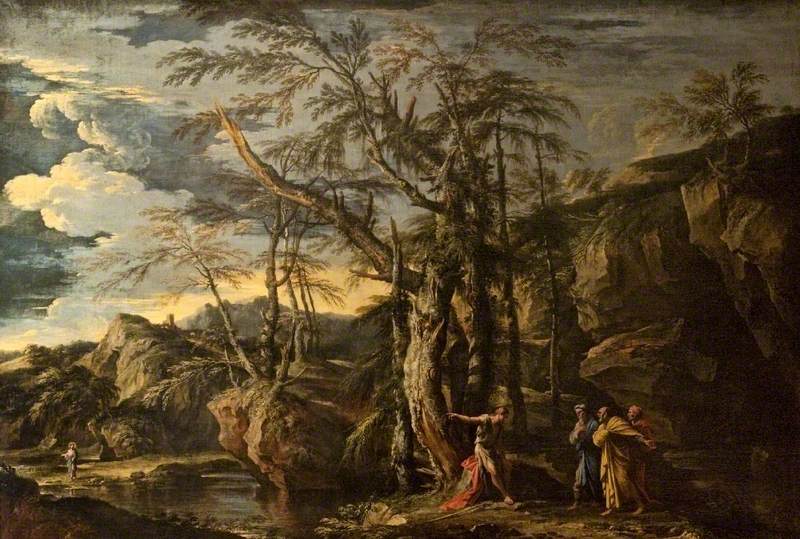
Salvator Rosa, born on June 20, 1615, in Naples, Italy, was a multifaceted artist whose contributions to painting, poetry, and theater have cemented his legacy as one of the most intriguing figures of the Baroque period. His life and work, marked by rebellion against artistic norms and a deep engagement with the themes of nature, war, and the supernatural, anticipated the Romantic movement that would emerge centuries later. This article explores the life, fame, and key highlights of Salvator Rosa’s career, delving into the nuances of his artistic achievements and the historical context that shaped his work.
Early Life and Artistic Beginnings
Salvator Rosa was born into a well-to-do family; his father, Vito Antonio de Rosa, was a respected lawyer in Naples. Despite his father’s hopes that Salvator would follow in his footsteps or pursue a career in the Church, it was evident from an early age that young Rosa was destined for a different path. His passion for art became apparent during his childhood, as he spent much of his time sketching and exploring creative pursuits.
After the death of his father in 1621, Rosa and his siblings were placed under the care of their grandfather. Salvator was sent to study with the Scolopi Fathers, though some accounts suggest he may have attended a school run by the Somascan Fathers. Regardless of the institution, it was during this period that Rosa’s artistic inclinations were nurtured.
Salvator’s first formal training in painting came from his uncle, Paolo Greco, and later from his brother-in-law, Francesco Fracanzano, both of whom were accomplished artists in their own right. However, it was under the tutelage of Aniello Falcone, a master of battle scenes, that Rosa’s distinctive style began to take shape. Falcone’s influence can be seen in the dynamic compositions and dramatic themes that would later characterize Rosa’s work.
The Journey to Rome and Early Success
In 1634, encouraged by the painter Giovanni Lanfranco, Salvator Rosa moved to Rome to further his artistic education and expand his horizons. Rome, the epicenter of the Baroque art movement, provided Rosa with the opportunity to immerse himself in a vibrant artistic community. He quickly became associated with the Bamboccianti, a group of genre painters known for their depictions of everyday life. However, Rosa soon grew disillusioned with their style, finding it too limiting for his creative ambitions.
During his time in Rome, Rosa also began to explore other forms of artistic expression, including theater. He collaborated with notable artists such as Claude Lorrain and Pietro Testa, contributing to satirical and carnivalesque performances. This period was marked by Rosa’s growing reputation as a versatile artist, but also by his clashes with established figures like Gian Lorenzo Bernini, with whom he often disagreed on artistic principles.
By 1636, Rosa had returned to Naples, where he began to focus on landscapes infused with dramatic and often violent themes. These works, which some art historians view as precursors to Romanticism, were not immediately appreciated by his contemporaries. Despite his undeniable talent, Rosa struggled to gain recognition in Naples, where the artistic scene was dominated by more established figures such as Jusepe de Ribera and Battistello Caracciolo.
Florence and the Height of Rosa’s Artistic Career
A significant turning point in Salvator Rosa’s career came in 1638 when he was invited to Rome by Cardinal Francesco Maria Brancaccio, who had recently been appointed Bishop of Viterbo. The Cardinal commissioned Rosa to create a religious painting for the Church of Santa Maria della Morte. The resulting work, “The Incredulity of St. Thomas,” showcased Rosa’s ability to handle sacred subjects with a unique intensity and realism. During this period, Rosa also befriended the poet Giovanni Battista Abati, who encouraged him to pursue his literary interests alongside his painting.
In 1639, Rosa moved to Florence, where he would remain for eight years. This period is often considered the most productive and creatively fulfilling of his career. In Florence, Rosa became a central figure in the cultural life of the city, founding the Accademia dei Percossi, an informal gathering of poets, writers, and artists. It was here that Rosa composed his famous satires, which took aim at the art world, society, and even his own profession. These writings, which include critiques of music, painting, poetry, and war, reveal Rosa’s sharp wit and disdain for the conventions of his time.
Florence was also where Rosa earned the nickname “Salvator delle Battaglie” (Salvator of the Battles) due to his skill in depicting grand and chaotic battle scenes. One of his most celebrated works from this period is the “Heroic Battle,” now housed in the Louvre, which exemplifies his mastery of composition and his ability to convey the tumultuous energy of war.
Beyond battle scenes, Rosa’s Florentine period was marked by a fascination with esoteric and mystical themes. Paintings like “Witches at Their Incantations” and “The Temptation of St. Anthony” reflect his interest in the supernatural and the darker aspects of human experience. These works, with their eerie atmospheres and complex symbolism, set Rosa apart from his contemporaries and foreshadowed the later developments of Gothic and Romantic art.
Return to Rome and Late Works
Salvator Rosa returned to Rome in the late 1640s, where he continued to produce works that challenged artistic norms and explored new thematic territories. His later paintings often moved away from the chaotic landscapes of his earlier years, focusing instead on classical subjects treated with a fresh perspective. Notable among these is “The Death of Socrates,” a painting that demonstrates Rosa’s ability to blend dramatic narrative with philosophical inquiry.
One of Rosa’s most ambitious works from this period is “The Spirit of Samuel Appearing to Saul,” a large canvas that vividly depicts the biblical story with a sense of supernatural terror and emotional intensity. This painting, which was later acquired by King Louis XIV of France, is a testament to Rosa’s mature style, characterized by its bold use of light and shadow and its powerful, almost cinematic, composition.
During his final years, Rosa’s reputation continued to grow, not only as a painter but also as a poet and intellectual. His works were sought after by collectors across Europe, and he enjoyed the patronage of some of the most influential figures of the time. Despite his success, Rosa remained a fiercely independent artist, often clashing with the artistic establishment and refusing to conform to the expectations of patrons and critics.
Legacy and Influence
Salvator Rosa died in Rome on March 15, 1673, at the age of 57. He was buried in the Church of Santa Maria degli Angeli, where his son, Augusto, later erected a monument in his honor. Rosa’s death marked the end of a career that had been as unconventional as it was influential.
Rosa’s legacy is multifaceted. As a painter, he is remembered for his dramatic landscapes, battle scenes, and depictions of the supernatural, all of which contributed to the development of Romanticism. His willingness to tackle unconventional subjects and his refusal to adhere to the rigid standards of the Baroque period made him a precursor to later movements that valued individual expression and artistic freedom.
As a poet and satirist, Rosa’s writings reveal a keen intellect and a critical eye. His satires, though less well-known than his paintings, offer valuable insights into the cultural and social issues of his time. They also provide a window into Rosa’s complex personality, marked by a deep skepticism of authority and a commitment to artistic integrity.
Rosa’s influence can be seen in the work of later artists who admired his rebellious spirit and his innovative approach to both art and literature. His life and work continue to be studied and celebrated for their originality and their impact on the trajectory of European art.
Conclusion
Salvator Rosa was not just a painter but a revolutionary figure who challenged the artistic conventions of his time. His works, filled with drama, intensity, and a touch of the macabre, broke away from the norms of the Baroque period and laid the groundwork for the Romantic movement that would follow. Rosa’s life was as dynamic and multifaceted as his art, marked by his travels, his encounters with influential figures, and his constant quest for creative freedom.
Today, Salvator Rosa is remembered as a pioneer who pushed the boundaries of what art could be. His paintings, satires, and writings continue to inspire and provoke, offering a rich legacy that speaks to the enduring power of artistic innovation. Whether through his evocative landscapes, his fierce battle scenes, or his biting satirical verse, Rosa’s work remains a testament to the restless, questioning spirit of an artist ahead of his time.


