
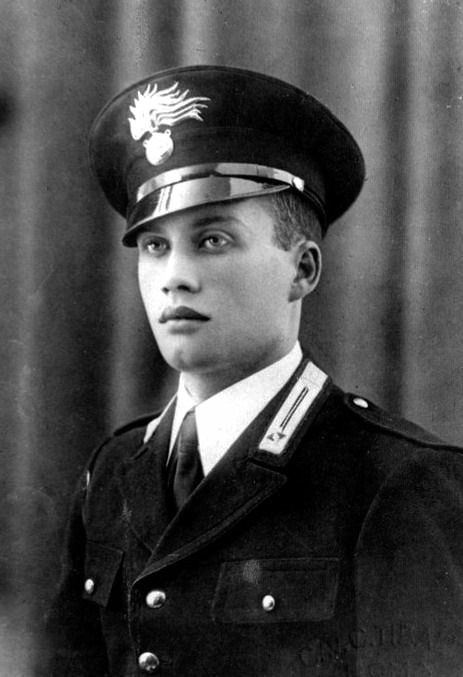
Salvo D’Acquisto is a name that resonates with heroism, sacrifice, and the spirit of selflessness. Born on October 15, 1920, in Naples, Italy, D’Acquisto became a symbol of courage during World War II, giving his life to save others from certain death. His story is one of extraordinary bravery, reflecting the profound impact of individual acts of heroism during times of immense hardship. This article explores his life, his ultimate sacrifice, and the enduring legacy he left behind.
Early Life and Background
Salvo D’Acquisto was born into a modest family in the Antignano district of Naples. His father, Salvatore, was of Sicilian descent from Palermo, while his mother, Ines, was a native of Naples. Salvo was the eldest of five children, with siblings named Franca, Rosario, Erminia, and Alessandro. Raised in a deeply religious environment, Salvo was taught the values of duty, honor, and sacrifice from an early age.
His early education took place at the Vanvitelli School, followed by his enrollment at the Giambattista Vico high school. Upon completing his secondary education, Salvo received his draft notice and chose to enlist voluntarily in the Carabinieri, a decision that aligned with his family’s tradition of military service. On August 15, 1939, Salvo officially joined the Carabinieri, a prestigious branch of the Italian armed forces responsible for both military and civilian policing.
Military Service and Early Career
After completing his training at the Carabinieri School, Salvo was assigned to the Territorial Legion in Rome. There, he served at the Nucleo Fabbriguerra in the Sallustiana district, where his duties involved maintaining order and security during a period of growing tension in Europe as World War II loomed on the horizon.
In November 1940, with the war already underway, Salvo volunteered to serve in Libya, joining the 608th Carabinieri Section near Tripoli. The war in North Africa was harsh, with Italian forces facing intense battles against the British and Allied troops. During his service in Libya, Salvo was injured, sustaining a wound to his leg. Despite his injury, he chose to remain with his unit, demonstrating a strong sense of duty and resilience. However, his service in North Africa was cut short when he contracted malaria, forcing him to return to Italy for treatment.
After recovering from his illness, Salvo continued his military career. In September 1942, he was sent to the Non-Commissioned Officers’ School in Florence, where he trained to become a sergeant. Shortly thereafter, he was promoted to the rank of vice-brigadier and assigned to the small rural town of Torrimpietra, located along the Via Aurelia, not far from Rome. It was here that Salvo would face the defining moment of his life.
The Events Leading to Sacrifice
The turning point in Salvo D’Acquisto’s life occurred in September 1943, following the Armistice of Cassibile, which marked Italy’s surrender to the Allied forces. The armistice created a power vacuum in Italy, leading to the German occupation of much of the country, including the area around Torrimpietra.
On September 22, 1943, a detachment of German SS troops arrived in the area and occupied several positions previously used by the Guardia di Finanza, including a location in Torre di Palidoro, which was under the jurisdiction of the Torrimpietra Carabinieri station. While inspecting some abandoned ammunition crates, a hand grenade accidentally detonated, killing two German soldiers and wounding two others. The explosion was purely accidental, but the Germans suspected sabotage and demanded retribution.
The German commander ordered the arrest of 22 local villagers, threatening to execute them if the perpetrators of the supposed attack were not identified. In the absence of the station’s marshal, Salvo D’Acquisto, as the senior officer present, took responsibility for investigating the incident. Despite his efforts to explain that the explosion was an accident, the German troops were not convinced and insisted on carrying out their reprisal.
On September 23, 1943, the situation escalated. The Germans rounded up the 22 villagers and forced them to dig a mass grave, making it clear that they intended to execute them. Salvo, aware of the desperate situation, made a fateful decision. To save the lives of the innocent villagers, he stepped forward and took full responsibility for the explosion, falsely confessing that he had been the one responsible for the supposed attack. This act of self-sacrifice was intended to spare the lives of the hostages.
The Ultimate Sacrifice
After his confession, the German soldiers released the 22 villagers, who quickly fled the scene. Salvo D’Acquisto was left alone, facing the German firing squad. Before his execution, he reportedly shouted, “Viva l’Italia!” (“Long live Italy!”), a final declaration of his patriotism and love for his country. The Germans then shot him, and his body was buried in the grave that the villagers had been forced to dig.
Salvo D’Acquisto was just 22 years old at the time of his death. His selfless act of courage and his willingness to lay down his life for the safety of others made him a national hero in Italy. His sacrifice exemplified the highest ideals of the Carabinieri and the values of honor, duty, and sacrifice.
Legacy and Commemoration
The legacy of Salvo D’Acquisto lives on in Italy and beyond. His story has been commemorated in numerous ways, and he is remembered as a symbol of heroism and moral integrity. Monuments, streets, and squares across Italy have been named in his honor, and his memory is preserved in the history of the Carabinieri.
In 1983, Salvo D’Acquisto was posthumously awarded the Gold Medal for Military Valor, Italy’s highest military decoration, in recognition of his extraordinary bravery and self-sacrifice. The citation for the medal praised his “heroic gesture” and his willingness to give his life “to save innocent victims.”
Salvo’s story also resonated within the Catholic Church. In 2001, Pope John Paul II referenced Salvo D’Acquisto in a speech to the Carabinieri, highlighting his sacrifice as an example of achieving “the summit of sanctity in the faithful and generous fulfillment of one’s duties.” The process for his beatification, a step toward sainthood in the Catholic Church, has been initiated, reflecting the profound impact of his actions on both secular and religious communities.
In addition to official honors, Salvo’s life and sacrifice have been depicted in various cultural works. His story has been the subject of films, books, and documentaries, ensuring that his heroism is not forgotten. These works have helped to keep his memory alive, inspiring future generations to reflect on the values of courage, selflessness, and moral responsibility.
Historical Context and Impact
Salvo D’Acquisto’s sacrifice must be understood within the broader historical context of World War II and the Italian Resistance. The period following the Armistice of Cassibile was one of chaos and brutality, with the German occupation forces conducting numerous reprisals against civilians in response to partisan activities and other perceived threats.
The German military’s policy of collective punishment was designed to terrorize the population and deter resistance. It often involved the execution of hostages, destruction of property, and other acts of violence against civilians. In this environment, acts of resistance and self-sacrifice, like that of Salvo D’Acquisto, were both rare and incredibly courageous.
Salvo’s decision to take the blame for an accident he did not cause, knowing that it would lead to his death, was a profound act of resistance against the occupying forces. It demonstrated the power of individual moral courage in the face of overwhelming oppression. His sacrifice also served as a powerful statement against the dehumanizing violence of war, highlighting the dignity and worth of every human life.
Conclusion
Salvo D’Acquisto’s life is a testament to the enduring power of courage, selflessness, and moral integrity. His decision to sacrifice his life to save others has left a lasting legacy, not only in Italy but around the world. As a symbol of heroism, he continues to inspire people to stand up for what is right, even in the face of unimaginable adversity.
The story of Salvo D’Acquisto reminds us of the profound impact that one individual can have on the lives of many. His actions during a dark chapter in history serve as a beacon of hope and a reminder of the human capacity for goodness, even in the most challenging circumstances.


