
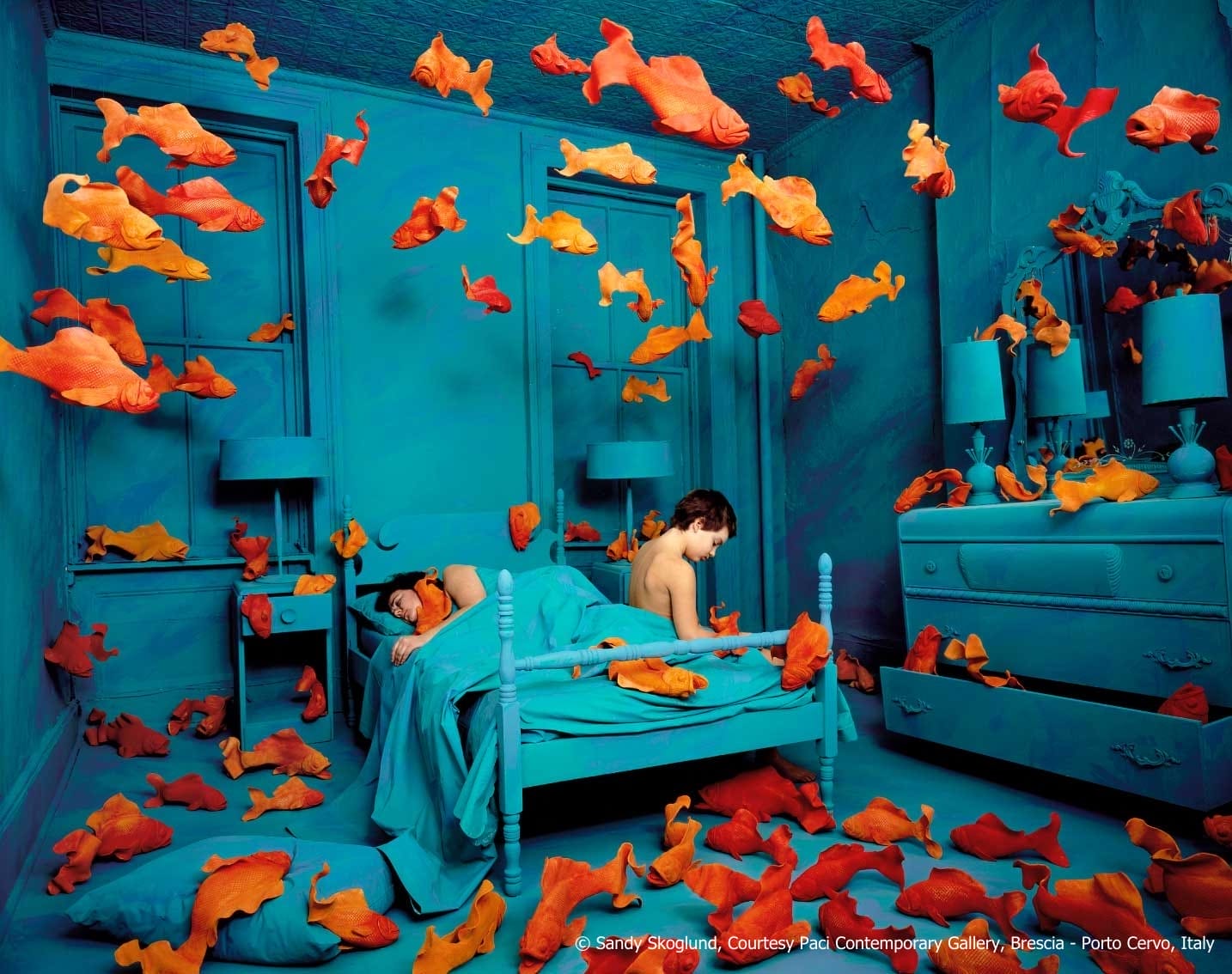
Sandy Skoglund is a name that stands out in the realm of contemporary art, particularly for her distinctive approach to conceptual photography and installation art. Born on September 11, 1946, in Quincy, Massachusetts, Skoglund’s work is a fascinating blend of surrealism, intricate craftsmanship, and sharp social commentary. Over the years, she has become a prominent figure in the art world, known for her elaborately staged scenes that often feature vibrant colors, bizarre settings, and an array of handcrafted elements.
Early Life and Education
Sandy Skoglund’s journey into the world of art began in her hometown of Quincy, Massachusetts. From an early age, she showed a keen interest in the visual arts, a passion that would eventually lead her to pursue formal education in the field. Skoglund attended Smith College, where she earned her Bachelor of Arts degree in studio art and art history in 1968. Her education did not stop there; she continued her studies at the University of Iowa, earning a Master of Fine Arts in painting in 1972.
During her time at the University of Iowa, Skoglund was introduced to various artistic mediums, including printmaking and filmmaking. However, it was photography that ultimately captured her interest. The ability to manipulate reality and create entirely new worlds through the lens of a camera fascinated her, and it was this interest that would shape her career as an artist.
The Evolution of Skoglund’s Art
Sandy Skoglund’s artistic style evolved significantly over the years. After completing her education, she moved to New York City in 1972, where she began experimenting with photography. Initially, her work was focused on still life compositions, but she soon became interested in the potential of photography as a tool for creating complex, staged scenes.
One of the key aspects of Skoglund’s work is the meticulous preparation that goes into each piece. Unlike traditional photography, which captures moments in time, Skoglund’s process involves the creation of elaborate sets, often constructed from scratch. These sets are filled with handcrafted sculptures, carefully arranged props, and, in many cases, brightly colored animals—elements that contribute to the surreal and sometimes unsettling atmosphere of her images.
Skoglund’s work is characterized by its use of color, repetition, and the juxtaposition of the familiar with the fantastical. Her scenes often depict ordinary domestic environments that are invaded by unexpected elements, such as a swarm of bright green cats or a group of orange foxes. This clash between the mundane and the surreal is a hallmark of her style, inviting viewers to question the boundaries between reality and imagination.
Iconic Works and Rise to Fame
Sandy Skoglund’s rise to fame can be attributed to a number of iconic works that have become synonymous with her name. One of her most famous pieces, “Radioactive Cats,” created in 1980, is a striking example of her unique approach to art. The image features an elderly couple in a gray, sterile kitchen, seemingly oblivious to the dozens of neon green cats that surround them. The contrast between the drab environment and the vibrant cats creates a powerful visual impact, drawing attention to the surreal nature of the scene.
Another notable work is “Revenge of the Goldfish,” produced in 1981. In this piece, a bedroom is filled with over a hundred bright orange fish, each carefully sculpted by Skoglund herself. The image portrays a child and a woman, both appearing calm and indifferent to the chaotic invasion of fish in their space. This work, like many of Skoglund’s other pieces, explores themes of alienation, the absurdity of everyday life, and the human tendency to ignore the strange or uncomfortable aspects of our surroundings.
Revenge of the Goldfish gained additional recognition when it was used as the cover art for the 1992 album by the band Inspiral Carpets, further cementing Skoglund’s status as a cultural icon.
The Philosophy Behind the Art
Sandy Skoglund’s work is deeply rooted in her philosophical approach to art and life. In various interviews, she has spoken about her interest in exploring the relationship between humans and their environments, as well as the ways in which we interact with the world around us. Her art often serves as a commentary on the complexities of modern life, highlighting the absurdities and contradictions that define our existence.
One of the central themes in Skoglund’s work is the concept of constructed reality. By meticulously creating every element of her scenes, she blurs the line between what is real and what is artificial. This approach challenges the viewer to reconsider their perceptions of reality and to question the nature of the world they inhabit.
Skoglund’s use of animals in her work is also significant. The animals, often depicted in unnatural colors and settings, serve as symbols of the intrusion of the wild into the domestic sphere. They represent the unpredictability of life and the ways in which the natural world disrupts the order we attempt to impose on our surroundings. This theme is particularly relevant in today’s world, where the impact of human activity on the environment is an increasingly pressing concern.
Later Career and Continued Influence
As Sandy Skoglund’s career progressed, her work continued to evolve, both in terms of scale and complexity. She began to create larger and more intricate installations, incorporating a wider range of materials and techniques. Despite the labor-intensive nature of her process, Skoglund has remained committed to producing work that is entirely handcrafted, rejecting the use of digital manipulation in favor of traditional methods.
In 2019, Skoglund’s work was celebrated in a major retrospective exhibition titled “Visioni Ibride” (Hybrid Visions) at the Centro Italiano per la Fotografia in Turin, Italy. The exhibition featured over a hundred of her works, spanning her entire career from the 1970s to her most recent piece, “Winter,” which took over a decade to complete. This exhibition was a testament to Skoglund’s enduring influence and her ability to captivate audiences with her imaginative and thought-provoking art.
Legacy and Impact on Contemporary Art
Sandy Skoglund’s contributions to the world of contemporary art are significant and far-reaching. Her innovative approach to photography and installation art has inspired countless artists and has had a lasting impact on the way we think about the relationship between reality and representation.
One of the key aspects of Skoglund’s legacy is her ability to combine technical skill with a deep understanding of the human condition. Her work resonates on multiple levels, offering both a visual feast for the eyes and a profound commentary on the nature of existence. In an age where digital manipulation is becoming increasingly prevalent in the art world, Skoglund’s commitment to traditional methods and her emphasis on the handcrafted nature of her work stand as a powerful reminder of the value of authenticity and craftsmanship.
Moreover, Skoglund’s work continues to be relevant in discussions about environmentalism, consumerism, and the impact of technology on our lives. Her surreal, dreamlike images serve as a mirror to the world we live in, reflecting the absurdities and contradictions that define modern life. Through her art, Skoglund invites us to confront these issues and to consider the ways in which we can find meaning and beauty in the chaos of everyday life.
Conclusion
Sandy Skoglund is more than just an artist; she is a visionary who has pushed the boundaries of what is possible in photography and installation art. Her work challenges us to see the world in new ways, to question our perceptions of reality, and to embrace the unexpected. As we continue to navigate the complexities of the modern world, Skoglund’s art serves as a powerful reminder of the importance of creativity, imagination, and the pursuit of truth.
Her legacy will undoubtedly continue to inspire future generations of artists, as her work remains a touchstone in the world of contemporary art. For those who seek to understand the intersection of art, life, and the human experience, Sandy Skoglund’s work offers a rich and endlessly fascinating exploration of these themes.


