
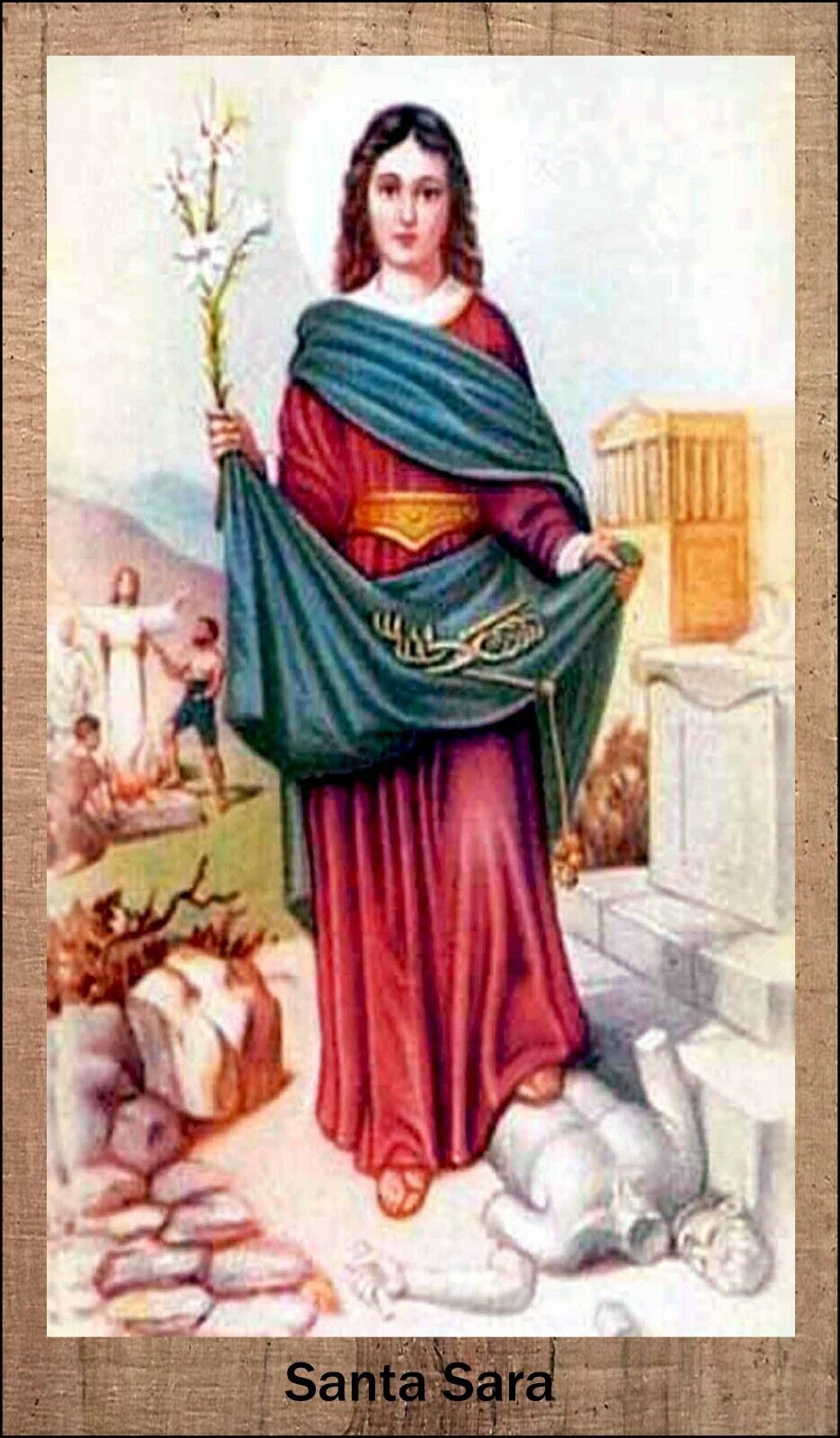
Santa Sara, a figure revered across multiple religious traditions, is one of the most enigmatic and influential women in religious history. Known as the wife of Abraham and the mother of Isaac, Santa Sara’s life and legacy have been deeply rooted in the sacred texts of Christianity, Judaism, and Islam. Her story is intertwined with themes of faith, perseverance, and divine intervention, making her a pivotal character in the narratives that shape these monotheistic religions.
Early Life and Marriage to Abraham
Santa Sara, born in 2028 B.C., was a woman of noble character and extraordinary beauty. Her birth name, Sarai, is thought to mean “my princess,” but it was later changed to Sara, which means “princess” or “noblewoman.” Sara was born to Terah, making her the half-sister of Abraham, whom she would later marry. Their union was not just a marital bond but also a foundational pillar in the development of the Abrahamic faiths.
The marriage between Sara and Abraham took place in the ancient city of Ur. However, their relationship faced immediate challenges. Abraham, fearing for his life due to Sara’s striking beauty, asked her to pretend to be his sister rather than his wife. This led to a series of events where Sara was twice abducted by powerful rulers—the Pharaoh of Egypt and King Abimelech. In both instances, divine intervention played a crucial role in securing her release, underscoring the protective hand of God over her life.
Motherhood and the Birth of Isaac
Despite her beauty and nobility, Sara faced the profound challenge of infertility, a significant social stigma in ancient times. For many years, she remained childless, a source of deep personal sorrow. In an attempt to fulfill the cultural and familial expectations, Sara gave her maidservant, Hagar, to Abraham, hoping to have a child through her. This union produced Ishmael, who was initially considered the heir to Abraham’s lineage.
However, Sara’s destiny was far from ordinary. At the age of 90, long after the natural age of childbearing, God promised Abraham that Sara would bear a son. The fulfillment of this promise came with the birth of Isaac, whose name means “laughter,” reflecting Sara’s initial incredulity and subsequent joy at the miraculous news. Isaac’s birth was not only a personal triumph for Sara but also a pivotal moment in the history of the Jewish people, as he became the legitimate heir to Abraham, the forefather of the Israelites.
Sara’s Legacy and Death
Sara’s life did not end with the birth of Isaac. She continued to play a significant role in the life of her family until her death at the age of 127, a remarkable lifespan even by biblical standards. Her death and burial are recorded in the Book of Genesis, where Abraham purchases the Cave of Machpelah in Hebron as a family burial site. This site, known as the Tomb of the Patriarchs, remains a sacred location for Jews, Christians, and Muslims alike.
Sara’s burial in this hallowed ground symbolizes her enduring legacy and her status as a matriarch of the Abrahamic faiths. Her life, marked by trials and divine blessings, serves as a testament to the power of faith and the fulfillment of God’s promises.
Santa Sara in Religious Texts
The story of Santa Sara is primarily found in the Old Testament, particularly in the Book of Genesis. However, her influence extends beyond the Hebrew Bible. In the New Testament, she is mentioned in the Epistles of St. Paul and the First Epistle of Peter, where she is held up as an example of faith and obedience. St. Paul, in his Letter to the Galatians, uses Sara as an allegory for the covenant of grace, contrasting her with Hagar, who represents the covenant of the law.
The reverence for Sara is also evident in the Islamic tradition, although she is less prominently featured. In the Quran, while Sara is not mentioned by name, the narrative of Isaac’s birth is recounted, with emphasis on the miraculous nature of the event. Sara’s role as the mother of Isaac and the wife of Abraham places her in a position of honor within Islamic teachings.
The Cult of Santa Sara
Despite her significant role in religious history, Santa Sara does not have a dedicated feast day in the liturgical calendars of most Christian denominations. Instead, she is commemorated alongside her husband, Abraham, on October 9th. The Catholic Church also remembers her on December 24th, within the context of the ancestors of Jesus Christ.
The only Christian denomination that celebrates Santa Sara exclusively is the Coptic Orthodox Church, which honors her on August 19th. This date reflects the particular veneration of Sara in the Coptic tradition, where she is recognized as a model of faith and perseverance.
In Islam, while Sara is not a central figure, she is respected as the mother of Isaac and the first wife of Abraham. The Islamic tradition views both Isaac and Ishmael, her stepson, as prophetic figures, underscoring the shared heritage between Judaism, Christianity, and Islam.
Santa Sara in Literature and Art
Santa Sara’s influence extends beyond religious texts into the realms of literature and art. One of the most notable literary references to Sara is found in Dante Alighieri’s Divine Comedy. In the 32nd Canto of Paradiso, Sara is mentioned among the blessed women in heaven, alongside other revered biblical figures such as Rebecca and Rachel. Dante’s inclusion of Sara in this celestial assembly reflects her esteemed place in Christian tradition.
Artists throughout history have also depicted scenes from Sara’s life, particularly the moment when she overhears the angels’ prophecy of Isaac’s birth. These artworks often emphasize her surprise and joy, capturing the emotional depth of her story. Renaissance painters, in particular, were drawn to the dramatic elements of her life, portraying her as a figure of grace and dignity.
The Historical and Cultural Significance of Santa Sara
The historical and cultural significance of Santa Sara cannot be overstated. As a matriarch of the Abrahamic faiths, her life story is a cornerstone of religious tradition and identity. Her experiences reflect the broader themes of struggle, faith, and divine intervention that are central to the narratives of Judaism, Christianity, and Islam.
In many ways, Santa Sara’s story is also a reflection of the status of women in ancient times. Her initial barrenness, her decision to give Hagar to Abraham, and her eventual motherhood at an advanced age all speak to the societal pressures and personal challenges that women faced. Despite these challenges, Sara’s story is ultimately one of triumph, where faith and perseverance lead to divine fulfillment.
In contemporary discussions, Santa Sara’s life continues to inspire and resonate, particularly in the context of discussions about faith, gender roles, and the intersection of religious traditions. Her legacy serves as a reminder of the enduring power of belief and the ways in which individual lives can shape the course of history.
Conclusion
Santa Sara remains a figure of immense spiritual significance across multiple religions. Her life, filled with trials, faith, and divine promises, has left an indelible mark on the religious consciousness of millions. As the wife of Abraham and the mother of Isaac, she stands as a testament to the enduring power of faith and the miraculous ways in which divine promises can be fulfilled. Her story, rich in historical and cultural context, continues to be a source of inspiration and reverence in the modern world.


