
Introduction
Sant’Agata, also known as Saint Agatha, is one of the most revered saints in the Christian tradition, particularly in the Roman Catholic Church. Her story, a powerful narrative of faith, martyrdom, and unwavering commitment to her beliefs, has inspired millions across the globe for centuries. Celebrated on February 5th, the day of her martyrdom, Sant’Agata’s life and legacy offer deep insights into the early Christian church’s struggles and the role of women within it.
Early Life of Sant’Agata
Born on September 8th, in either 235 or 238 AD, Sant’Agata hailed from Catania, a city on the island of Sicily, Italy. Her parents, Rao and Apolla, were likely of noble descent, which provided Agata with a life of privilege. However, from an early age, she chose a path of devout faith over the comforts of her status. By the age of 21, Agata had consecrated herself to God, taking on the role of a deaconess within her Christian community. This position was not merely symbolic; Agata was deeply involved in the catechesis, instructing new converts in the Christian faith and preparing them for baptism, communion, and confirmation.
The Struggles and Persecution of Sant’Agata
The mid-third century was a tumultuous time for Christians in the Roman Empire. The Emperor Decius, in his efforts to restore traditional Roman values and religion, issued an edict that led to the persecution of Christians. In this context, Quinziano, the proconsul of Sicily, arrived in Catania with a specific mission: to make Christians publicly renounce their faith.
Quinziano became infatuated with Agata, but upon learning of her religious devotion, he ordered her to repudiate her Christian beliefs. Agata’s refusal to worship the pagan gods marked the beginning of her persecution. She was placed under the custody of Afrodisia, a corrupt courtesan, and her daughters, who attempted to morally corrupt Agata through psychological pressure, threats, and temptations. Despite these severe trials, Agata’s faith remained unshaken, and Afrodisia eventually returned her to Quinziano, having failed to break her spirit.
Martyrdom of Sant’Agata
Frustrated by Agata’s steadfastness, Quinziano resorted to more brutal methods. Agata was subjected to a series of tortures designed to force her to renounce her faith. Initially, she was flogged, and then subjected to a particularly horrific form of torture where her breasts were severed with pincers. This gruesome act is one of the most remembered aspects of her martyrdom, symbolizing her suffering and resilience.
According to legend, that night, Sant’Agata received a miraculous visitation from Saint Peter, who healed her wounds and reassured her of her faith. However, Quinziano’s cruelty did not end there. Agata was forced to walk over burning coals, an ordeal that she survived but which left her gravely injured. Finally, on the night of February 5th, 251 AD, Agata succumbed to her injuries and died in her prison cell, maintaining her faith until her last breath.
The Relics and Veneration of Sant’Agata
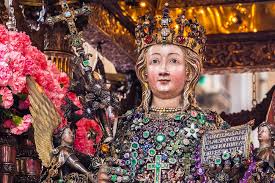
The veneration of Sant’Agata began almost immediately after her death. Her relics, which include her bones and other bodily fragments, have been revered as holy objects with miraculous powers. In 1126, her remains were returned to Catania after being taken to Constantinople by the Byzantine general Giorgio Maniace. Today, her relics are housed in the Cathedral of Catania, where they are kept in a silver bust and a silver chest.
The influence of Sant’Agata’s veneration is widespread. Besides Catania, other cities in Italy and abroad claim to possess relics of the saint, including hair and bone fragments. For instance, a legend suggests that one of her breasts is preserved in a convent of Franciscan friars in Galatina, Puglia.
Patronage and Cultural Significance of Sant’Agata
Sant’Agata’s influence extends beyond her martyrdom, encompassing various aspects of daily life and professions. She is particularly venerated as the patroness of:
- Bell-makers: Bells, which were rung during significant events, became associated with Sant’Agata, believed to protect those who invoked her name.
- Weavers: A Christianized version of Penelope from Greek mythology, Agata is said to have tricked a suitor by weaving a cloth during the day and unraveling it at night, a story that highlights her patience and wisdom.
- Firefighters (especially in Argentina): During the medieval period, Sant’Agata was invoked for protection against fires, a tradition that continues to this day in certain regions.
- Women with breast-related illnesses: Due to the nature of her martyrdom, she is particularly revered by those suffering from breast diseases.
Sant’Agata is also called upon in times of natural disasters, particularly volcanic eruptions and other environmental catastrophes. Her role as a protector is encapsulated in the Latin phrase, “Noli offendere patriam Agathae, quia ultrix iniuriarum est” (Do not offend the country of Agata, for she is the avenger of injuries).
The Global Reach of Sant’Agata’s Patronage
Sant’Agata’s patronage extends far beyond her native Catania. She is the patron saint of numerous towns and cities across Italy, including:
- Martinengo
- Basiglio
- Monticello Brianza
- Capua
- Asciano
- Radicofani
- Gallipoli
- Palermo
- Santhià
- Sant’Agata sul Santerno
- Bulgarograsso
- Faedo
- Ornago
- Montiano e Guarda Bosone
Internationally, Sant’Agata is also honored in places like Mdina in Malta, Alsasua in Spain, Le Fournet in France, and Agathaberg in Germany. Her global reach underscores the universal appeal of her story, one of a young woman who stood firm in her beliefs against overwhelming odds.
Historical Context and Legacy
The story of Sant’Agata is set against the backdrop of the early Christian church’s persecution under Roman rule. Her life exemplifies the struggles faced by early Christians, particularly women, who were often subjected to brutal treatment for their faith. The intensity of her suffering, coupled with her unwavering dedication, has made her a powerful symbol of Christian martyrdom.
Moreover, the preservation of her story and the veneration of her relics highlight the importance of saints in the Christian tradition as intercessors and protectors. The continued celebration of her feast day, particularly in Catania, where a grand festival is held annually, reflects the deep cultural and religious significance that Sant’Agata holds for the people of Sicily and beyond.
In a broader sense, Sant’Agata’s story offers insights into the role of women in early Christian history. As a deaconess, she played a crucial role in the religious community, a fact that is often overlooked in discussions of church history. Her resistance to Quinziano’s advances and her refusal to abandon her faith serve as a testament to the strength and agency of women in the early church.
Conclusion
Sant’Agata remains a towering figure in Christian hagiography. Her life and martyrdom continue to inspire countless believers around the world. From her early life in Catania to her brutal persecution and eventual sainthood, Sant’Agata’s story is one of resilience, faith, and unyielding devotion. Her legacy lives on, not only in the relics and churches dedicated to her but also in the hearts and minds of those who look to her as a symbol of divine protection and strength.


