
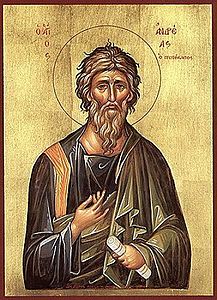
Sant’Andrea Apostolo, also known as Saint Andrew the Apostle, holds a significant place in Christian history as one of the first disciples of Jesus Christ and the brother of Simon Peter, another prominent apostle. Born in the town of Bethsaida, a major coastal city near the Sea of Galilee, around 6 BC, Andrea’s life is a testament to his faith, dedication, and missionary zeal. This article delves into the life, influence, and legacy of Sant’Andrea Apostolo, exploring his role in the early Christian church and his enduring impact across various cultures and regions.
Early Life and Background
Sant’Andrea was born in Bethsaida, a city whose name translates to “house of the fisherman,” reflecting the primary occupation of its inhabitants. The region fell under the rule of Herod Philip, son of Herod the Great, and was later renamed “Julias” in honor of the Roman Emperor Augustus’s daughter. Andrea, like his brother Simon Peter, was a fisherman by trade, following in the footsteps of their father, Jonah, also known as John.
Andrew’s life took a pivotal turn when he became a disciple of John the Baptist. It was through John that Andrew first learned of Jesus Christ. Upon meeting Jesus, Andrew recognized Him as the Messiah and immediately brought his brother Simon Peter to Jesus, thus becoming one of the earliest followers of Christ. This act of introducing Peter to Jesus earned Andrew the title of “Protoclete,” or “first-called,” among the apostles.
The Apostolic Mission
As one of Jesus’s closest disciples, Andrew played a crucial role in spreading the Christian faith. According to the Gospels, Andrew and Peter were called by Jesus to become “fishers of men,” a metaphor for their future mission of evangelism. Andrew’s commitment to this mission led him on extensive travels, preaching the Gospel across various regions, including Asia Minor, modern-day Romania, Russia, and even as far as Constantinople (now Istanbul). His missionary work laid the foundation for several Christian communities, particularly in the Eastern Orthodox tradition.
Andrew’s travels are a testament to his unwavering dedication to spreading the teachings of Jesus. His efforts to evangelize the people of these regions, often in the face of great danger, highlight his role as a key figure in the early Church. His presence in Byzantium, where he is believed to have established the See of Byzantium (later Constantinople), is particularly significant, as it marked the beginning of a Christian tradition that would eventually lead to the foundation of the Eastern Orthodox Church.
Martyrdom of Sant’Andrea
Sant’Andrea’s life, like that of many apostles, ended in martyrdom. He was crucified in the city of Patras in present-day Greece on November 30, 60 AD, during the reign of the Roman Emperor Nero. However, Andrew’s crucifixion was distinct from that of Jesus. According to tradition, Andrew was crucified on an X-shaped cross, known as a “saltire” or “Saint Andrew’s Cross,” at his own request. He felt unworthy to be crucified on the same type of cross as Jesus.
Andrew’s martyrdom is a powerful testament to his humility and deep reverence for Christ. Tied, rather than nailed, to the cross, he is said to have preached to those around him for two days before succumbing to death. This act of preaching even in his final moments underscores his lifelong commitment to spreading the Gospel, making him a revered figure in Christian history.
The Journey of Relics
The relics of Sant’Andrea have a storied history, reflecting the reverence with which he has been regarded throughout Christian history. Following his death, Andrew’s relics were initially kept in Patras but were later moved to Constantinople, the capital of the Byzantine Empire, by order of Emperor Constantius II in 357 AD. This transfer was part of a broader effort by the emperor to centralize the relics of the apostles in the newly established Christian capital.
However, the journey of Andrew’s relics did not end there. During the Fourth Crusade in 1204, Cardinal Pietro Capuano, an Italian cleric, took the relics from Constantinople and brought them to the town of Amalfi in Italy. Today, Amalfi remains a major center of veneration for Sant’Andrea, with his relics enshrined in the Cathedral of Amalfi, which is dedicated to him.
In addition to Amalfi, portions of Andrew’s relics are found in several other locations, including a part of his skull housed in St. Peter’s Basilica in Rome. In 1964, in a gesture of ecumenical goodwill, Pope Paul VI returned some of these relics to the Greek Orthodox Church in Patras. This act was seen as a significant step towards healing the historical rift between the Eastern and Western Christian traditions.
The Apocryphal Writings
While the canonical Gospels of Matthew, Mark, Luke, and John are the most widely recognized accounts of the life of Christ, several apocryphal texts also offer insights into the lives of the apostles, including Sant’Andrea. One of the most notable of these is the “Acts of Andrew,” a non-canonical text that details the apostle’s missionary journeys, miracles, and martyrdom.
Although these writings were excluded from the official canon of the Bible, they provide a fascinating glimpse into the early Christian imagination and the ways in which the apostles were revered by the faithful. The “Acts of Andrew” was particularly popular in the early Christian centuries, despite being condemned by the Church as apocryphal. The text was later rediscovered and published in the 19th century by the German scholar Konstantin von Tischendorf, reigniting interest in Andrew’s life and legacy.
Cultural and Religious Influence
The influence of Sant’Andrea extends far beyond his role in the early Church. He is venerated as the patron saint of several countries, including Scotland, Russia, Greece, and Romania, each of which has its own unique traditions and stories associated with the apostle.
In Scotland, Andrew is deeply revered, and his feast day on November 30th is celebrated as a national holiday. The Scottish flag, known as the Saltire, bears the white cross of Saint Andrew on a blue background, symbolizing the apostle’s crucifixion. According to legend, relics of Andrew were brought to Scotland in the 4th century, and the town of St. Andrews, which became a major center of Christian learning, was named in his honor. The apostle’s connection to Scotland is also linked to the Declaration of Arbroath in 1320, a historic document asserting Scotland’s independence and appealing to the pope for protection under the patronage of Saint Andrew.
In Greece, particularly in Patras, Sant’Andrea is honored with great reverence. The Basilica of St. Andrew in Patras is one of the largest churches in the Balkans, and it houses a relic of the apostle’s cross. The annual celebrations on his feast day are marked by processions, liturgies, and other religious observances, reflecting the deep spiritual connection between the people of Patras and their patron saint.
Romania also holds Andrew in high esteem, where he is considered the first missionary to bring Christianity to the region. The Cave of Saint Andrew in Romania is a significant pilgrimage site, believed to be the place where the apostle lived and preached during his mission in the area. The Romanian Orthodox Church celebrates Andrew’s feast day with special services and rituals, emphasizing his role as the “Apostle of the Romanians.”
In Russia, Saint Andrew is regarded as the patron saint of the Russian Navy, and the Order of Saint Andrew is the highest state decoration of the Russian Federation. The apostle’s legacy in Russia is closely tied to the tradition that he evangelized the areas around the Black Sea and up the Dnieper River, establishing a Christian presence that would later flourish into the Russian Orthodox Church.
The Feast Day and Modern Celebrations
Sant’Andrea’s feast day, celebrated on November 30th, is observed by both the Eastern Orthodox and Western Christian traditions. The day is marked by various religious services, processions, and celebrations that highlight the apostle’s contributions to the spread of Christianity.
In Scotland, Saint Andrew’s Day is celebrated with cultural events, including traditional Scottish music, dancing, and food. The day is also seen as a time to celebrate Scottish heritage and national pride, with many Scots around the world participating in the festivities.
In Italy, particularly in Amalfi, the feast day is celebrated with a grand procession of the saint’s relics through the streets of the town, accompanied by prayers, hymns, and fireworks. The procession is a key event in the religious calendar of Amalfi and draws pilgrims and visitors from around the world.
In Patras, Greece, the feast day is a major religious event, with thousands of faithful participating in the liturgies and processions held in honor of the apostle. The celebrations are marked by a deep sense of reverence and devotion, reflecting the strong bond between the people of Patras and their patron saint.
Conclusion
Sant’Andrea Apostolo’s life and legacy are deeply intertwined with the history and spread of Christianity across the globe. From his humble beginnings as a fisherman in Bethsaida to his role as a missionary and martyr, Andrew’s story is one of faith, dedication, and sacrifice. His influence can be seen in the many churches, traditions, and cultural practices that have developed in his honor over the centuries.
As the patron saint of numerous countries and regions, Sant’Andrea continues to inspire millions of believers around the world. His feast day on November 30th serves as a reminder of his contributions to the Christian faith and the enduring legacy he left behind. Whether in Scotland, Greece, Romania, or beyond, the story of Sant’Andrea Apostolo remains a powerful testament to the enduring power of faith and the impact of one man’s devotion to spreading the Gospel.


