
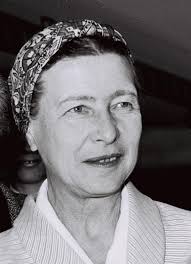
Simone de Beauvoir, born on January 9, 1908, in Paris, France, is one of the most influential intellectuals of the 20th century. A philosopher, writer, feminist, and social theorist, de Beauvoir’s work has had a profound impact on feminist theory, existentialism, and modern thought. Her most famous work, “The Second Sex,” is a foundational text in feminist philosophy, offering a deep and critical analysis of women’s oppression and their societal roles. De Beauvoir’s life was as groundbreaking as her work, characterized by a relentless pursuit of intellectual freedom, social justice, and the exploration of human existence.
Early Life and Education
Simone de Beauvoir was born into a bourgeois family in Paris. Her father, Georges Bertrand de Beauvoir, was a legal secretary with aristocratic pretensions, while her mother, Françoise Brasseur, was deeply religious. The family’s fortunes declined after her maternal grandfather went bankrupt, leading to financial difficulties that contrasted sharply with the family’s aristocratic aspirations. Despite the economic challenges, Simone’s parents ensured she received a rigorous education, reflecting their high expectations for her future.
From an early age, de Beauvoir showed a remarkable intellectual curiosity and a passion for reading and writing. By the age of ten, she was already expressing a desire to become a writer. Her education began at the Institut Désir, where she excelled academically, particularly in literature and philosophy. However, it was during her time at the Lycée Fénelon and later at the Institut Catholique de Paris and the Sorbonne that de Beauvoir’s intellectual pursuits truly flourished. It was at the Sorbonne that she studied philosophy, eventually earning her agrégation in philosophy in 1929, a highly competitive qualification in the French education system.
It was during her university years that de Beauvoir formed significant relationships with other intellectuals who would shape her philosophical outlook. Among them were Claude Lévi-Strauss, Raymond Aron, Maurice Merleau-Ponty, and, most importantly, Jean-Paul Sartre. Sartre and de Beauvoir’s relationship was unconventional and intellectually stimulating, characterized by a deep intellectual partnership that would last until Sartre’s death.
The Intellectual Partnership with Jean-Paul Sartre
The relationship between Simone de Beauvoir and Jean-Paul Sartre is one of the most famous intellectual partnerships of the 20th century. Though they never married, their union was a profound meeting of minds, built on mutual respect, intellectual collaboration, and a shared commitment to existentialism. They rejected the traditional conventions of marriage and monogamy, instead opting for a relationship based on freedom and honesty, which they referred to as an “essential” love that was open to other “contingent” loves.
Their relationship was not without its complexities and controversies, but it was deeply influential in shaping both of their philosophical ideas. Together, they explored and developed the ideas that would come to define existentialism, a philosophical movement that emphasizes individual freedom, responsibility, and the inherent meaninglessness of life, which must be confronted and transcended by the individual.
Sartre and de Beauvoir supported each other’s work, often discussing and critiquing each other’s writings. While Sartre is often credited as the father of existentialism, de Beauvoir’s contributions were equally significant, particularly in how she applied existentialist ideas to issues of gender, ethics, and social justice.
Literary Career and Major Works
Simone de Beauvoir’s literary career began in earnest in the 1940s, and she quickly established herself as a formidable intellectual and writer. Her first novel, “L’Invitée” (She Came to Stay), published in 1943, explores the dynamics of relationships and the existential themes of freedom and responsibility. The novel is semi-autobiographical, reflecting de Beauvoir’s own experiences and her relationship with Sartre.
In 1944, she published “Le Sang des autres” (The Blood of Others), which delves into the moral complexities of resistance during World War II. The novel reflects de Beauvoir’s engagement with the French Resistance during the Nazi occupation, as well as her deep concerns about the ethical implications of violence and the responsibility individuals bear in times of war.
However, it was “Le Deuxième Sexe” (The Second Sex), published in 1949, that would cement Simone de Beauvoir’s place in history. This monumental work is a two-volume treatise that examines the historical, social, and psychological construction of women as the “Other” in a male-dominated society. De Beauvoir famously declared, “One is not born, but rather becomes, a woman,” challenging the essentialist views of gender and advocating for women’s emancipation from the roles imposed on them by society.
“The Second Sex” was revolutionary in its scope and impact, offering a comprehensive critique of patriarchy and laying the groundwork for modern feminist thought. The book’s exploration of how women have been historically oppressed and its call for women to assert their independence and agency resonated with readers around the world, sparking widespread debate and controversy. It remains a cornerstone of feminist philosophy and continues to influence discussions on gender and equality.
Political Engagement and Feminist Activism
Simone de Beauvoir’s intellectual work was deeply intertwined with her political activism. Throughout her life, she was a committed advocate for social justice, human rights, and feminism. In the 1940s, she, along with Sartre, founded the influential journal Les Temps Modernes, which became a platform for discussing existentialism, politics, and culture. The journal was also a space for de Beauvoir to publish many of her essays and articles, where she addressed pressing social issues and advocated for political change.
In the 1960s and 1970s, de Beauvoir became increasingly involved in the feminist movement. She was a vocal supporter of women’s rights, including reproductive rights and gender equality. Her activism extended to participating in protests and demonstrations, and she became a prominent figure in the French feminist movement. In 1971, she signed the Manifesto of the 343, a public declaration by 343 women who admitted to having illegal abortions, risking prosecution to protest against the restrictive abortion laws in France. This act of defiance was a significant moment in the fight for women’s reproductive rights.
De Beauvoir also founded the League for Women’s Rights in 1974, further solidifying her role as a leading feminist thinker and activist. Her work during this period reflected her continued commitment to exploring and addressing the systemic inequalities faced by women, particularly in the context of marriage, family, and society.
Later Years and Autobiographical Works
In the latter part of her life, Simone de Beauvoir turned her focus to autobiographical writing, producing a series of memoirs that provided insight into her personal life, her intellectual development, and her relationships. These works include “Mémoires d’une jeune fille rangée” (Memoirs of a Dutiful Daughter), “La Force de l’âge” (The Prime of Life), “La Force des choses” (Force of Circumstance), and “Tout compte fait” (All Said and Done).
These memoirs are not only valuable for their autobiographical content but also for their reflections on the broader social and political changes that occurred during de Beauvoir’s lifetime. They offer a candid and introspective look at her experiences as a woman, an intellectual, and a public figure, and they provide a nuanced understanding of her thoughts on existentialism, feminism, and the human condition.
In 1981, de Beauvoir published “La Cérémonie des adieux” (Adieux: A Farewell to Sartre), a moving account of Sartre’s final years and their relationship. The book is both a tribute to their partnership and a reflection on aging, mortality, and the process of saying goodbye to a loved one.
Legacy and Impact
Simone de Beauvoir’s legacy is immense and multifaceted. She is widely regarded as one of the most important feminist thinkers of the 20th century, and her work continues to influence contemporary discussions on gender, identity, and social justice. “The Second Sex” remains a seminal text in feminist theory, and its impact can be seen in the ongoing struggles for gender equality and women’s rights around the world.
De Beauvoir’s contributions to existentialism are also significant. Her exploration of freedom, responsibility, and the construction of the self has had a lasting influence on existentialist thought, and her works are studied alongside those of Sartre, Camus, and other existentialist philosophers.
Beyond her philosophical and feminist contributions, de Beauvoir’s life and work have inspired generations of women to challenge societal norms and assert their independence. Her courage in speaking out against oppression, her commitment to social justice, and her refusal to conform to traditional gender roles make her a timeless figure in the fight for equality.
Conclusion
Simone de Beauvoir was a trailblazing intellectual, a powerful writer, and a passionate advocate for social justice. Her work, particularly “The Second Sex,” has left an indelible mark on feminist philosophy and continues to inspire new generations of thinkers and activists. De Beauvoir’s life was one of relentless inquiry and a commitment to exploring the complexities of human existence, gender, and freedom.
Her intellectual partnership with Jean-Paul Sartre, her contributions to existentialism, and her unwavering dedication to feminist activism have cemented her place as one of the most important figures in 20th-century thought. As the world continues to grapple with issues of gender equality and social justice, Simone de Beauvoir’s work remains as relevant and impactful as ever.


