
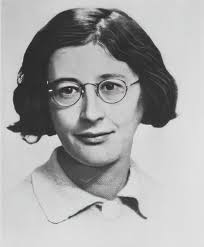
Simone Weil, born on February 3, 1909, in Paris, was a French philosopher, mystic, and political activist whose profound and often radical ideas left an indelible mark on 20th-century thought. Known for her intellectual rigor and deep commitment to social justice, Weil’s life was characterized by a relentless pursuit of truth, often at great personal cost. Her work spans a wide range of topics, including philosophy, religion, politics, and ethics, making her one of the most compelling and enigmatic figures of her time.
Early Life and Intellectual Formation
Simone Weil was born into an affluent and intellectual Jewish family in Paris. Her parents, Bernard and Selma Weil, provided a nurturing environment that emphasized education and intellectual curiosity. Weil’s older brother, André Weil, became a renowned mathematician, and the siblings shared a close bond, often engaging in deep intellectual discussions.
From an early age, Weil displayed exceptional intellectual abilities and a profound sense of empathy for the suffering of others. At just fourteen years old, she experienced a deep crisis of despair, brought on by the realization of the widespread suffering in the world. This crisis nearly drove her to suicide, but she ultimately overcame it, channeling her intense emotions into a lifelong commitment to social and political activism.
Weil’s formal education began at the Lycée Henri-IV, where she studied under the famous philosopher Émile-Auguste Chartier, known as Alain. Alain’s influence was significant, as he encouraged Weil to think critically and independently, laying the groundwork for her later philosophical explorations. In 1931, Weil graduated from the École Normale Supérieure with a degree in philosophy, and she began teaching in various provincial high schools across France.
Political Activism and Social Commitment
Weil’s early career as a teacher was marked by her deep involvement in political activism. Despite not formally joining any political party, she was closely associated with revolutionary movements, particularly those on the far left. Weil was deeply critical of the Soviet Union, becoming one of the first intellectuals to denounce the totalitarian tendencies of the Soviet regime, which she saw as a betrayal of the original ideals of the revolution.
Her commitment to social justice led her to engage directly with the working class. In 1934, Weil took a radical step by leaving her teaching position to work as a factory laborer. She wanted to experience firsthand the hardships and exploitation faced by workers in industrial society. Weil worked in various factories, including the Alsthom mechanical construction company in Paris, where she endured grueling conditions that took a severe toll on her health.
The experience of manual labor deeply influenced Weil’s thinking. She documented her experiences in her diaries, which later formed the basis for some of her most important philosophical writings. Through her work in the factories, Weil developed a profound understanding of the alienation and suffering inherent in industrial capitalism, which she saw as a system that dehumanized workers and stripped them of their dignity.
Spiritual Awakening and Religious Exploration
In the mid-1930s, Weil’s intellectual journey took a significant turn toward spirituality. A trip to Portugal in 1935 was a pivotal moment in her life, leading her to a deep engagement with Christianity. Witnessing a religious festival in a small fishing village, Weil was struck by the profound faith of the local people, which contrasted sharply with the materialism she had observed in urban industrial society.
This encounter ignited in Weil a profound spiritual awakening, and she began to explore Christianity in its most radical and ascetic forms. Despite her Jewish heritage, Weil was drawn to the figure of Christ, whom she saw as embodying the ultimate example of self-sacrifice and compassion for the suffering. Her spiritual journey was marked by an intense personal struggle to reconcile her intellectual beliefs with her newfound faith.
Weil’s religious exploration was not limited to Christianity. She also delved into the spiritual traditions of other cultures, including Hinduism and Buddhism. The Bhagavad Gita, a sacred Hindu text, had a particularly profound impact on her, and she studied Sanskrit to better understand its teachings. Weil saw in these texts a universal truth about the nature of suffering and the human condition, which resonated deeply with her own experiences and beliefs.
The Spanish Civil War and Moral Dilemmas
Weil’s political and spiritual commitments came to a head during the Spanish Civil War. In 1936, motivated by her belief in the struggle against fascism, Weil traveled to Spain to join the anarchist militia fighting against Franco’s forces. Despite her physical frailty and lack of military training, Weil was determined to contribute to the cause.
However, her time in Spain was short-lived and marked by disillusionment. Weil quickly became aware of the brutal realities of war, including the violence and atrocities committed by both sides. Her idealistic vision of the revolution clashed with the harsh realities of the conflict, leading her to question the efficacy of violence as a means of achieving social justice.
Weil’s experience in Spain was a turning point in her life, deepening her commitment to pacifism and reinforcing her belief in the importance of spiritual and moral integrity. She left Spain disillusioned but with a renewed determination to pursue her philosophical and spiritual ideals.
World War II and Exile in America
As World War II broke out, Weil found herself increasingly isolated due to her uncompromising beliefs. In 1940, after the fall of France to Nazi Germany, she fled to Marseille, where she became involved with the French Resistance. Weil’s commitment to the Resistance was driven by her deep sense of duty and her belief in the moral imperative to fight against tyranny.
Despite her efforts, Weil’s participation in the Resistance was limited by her poor health and her insistence on maintaining her intellectual independence. In 1942, she made the difficult decision to leave France and emigrate to the United States with her parents. However, her time in America was short, as she was determined to return to Europe to contribute more directly to the war effort.
While in New York, Weil connected with other intellectuals, including the philosopher Jacques Maritain. She continued to write and develop her ideas, but her health was rapidly deteriorating. Weil eventually made her way to London, where she joined the French Free Forces, working as a writer and editor for the Resistance.
Final Days and Legacy
Simone Weil’s life was tragically cut short in 1943 when she succumbed to tuberculosis in a sanatorium in Ashford, England, at the age of 34. Her death was hastened by her self-imposed restrictions on food, which she undertook as an act of solidarity with those suffering in occupied France. Weil’s death marked the end of a life characterized by intense intellectual and spiritual exploration, as well as a profound commitment to social justice.
Despite her short life, Weil’s influence has been far-reaching. Her writings, much of which were published posthumously, have inspired generations of thinkers, activists, and spiritual seekers. Weil’s work is characterized by its depth, rigor, and unflinching honesty. She tackled some of the most challenging questions of her time, including the nature of suffering, the role of religion in society, and the moral responsibilities of individuals and governments.
Weil’s legacy is also marked by her unique blend of political activism and mysticism. She remains a rare figure who bridged the gap between intellectual inquiry and spiritual practice, refusing to compartmentalize the different aspects of her life. Weil’s commitment to living according to her beliefs, even when it led to personal suffering, has made her a symbol of integrity and moral courage.
Philosophical Contributions and Key Works
Simone Weil’s philosophical contributions are vast and varied, touching on issues of ethics, politics, religion, and epistemology. One of her central themes was the concept of “attention,” which she described as the rarest and purest form of generosity. For Weil, attention was the foundation of both intellectual and moral life, requiring an openness to the truth and a willingness to be fully present to the world and to others.
Weil’s concept of “decreation” is another key element of her thought. This idea involves the voluntary renunciation of the self in order to align more fully with the divine will. For Weil, decreation was not an act of self-destruction but rather a way of transcending the ego to achieve a deeper union with God and a greater empathy for the suffering of others.
Among Weil’s most important works are “Gravity and Grace,” a collection of her reflections on religion and philosophy, and “The Need for Roots,” in which she explores the spiritual and cultural foundations necessary for a just society. These works, along with her numerous essays and letters, continue to be studied for their profound insights and their relevance to contemporary issues.
Conclusion: The Enduring Legacy of Simone Weil
Simone Weil’s life and work remain a source of inspiration and challenge to those who seek to understand the complexities of the human condition. Her relentless pursuit of truth, combined with her deep compassion for the suffering of others, set her apart as one of the most extraordinary figures of the 20th century. Weil’s legacy is not just intellectual but also deeply moral, reminding us of the importance of living in accordance with our deepest convictions, even in the face of overwhelming odds.
In an age where the lines between politics, religion, and ethics are increasingly blurred, Weil’s work offers a powerful reminder of the need for integrity and the courage to confront difficult truths. Her life serves as a testament to the possibility of living a life of purpose and meaning, grounded in a commitment to justice and a profound sense of empathy for the suffering of others. Simone Weil’s enduring legacy continues to resonate, offering insights that are as relevant today as they were in her own time.


