
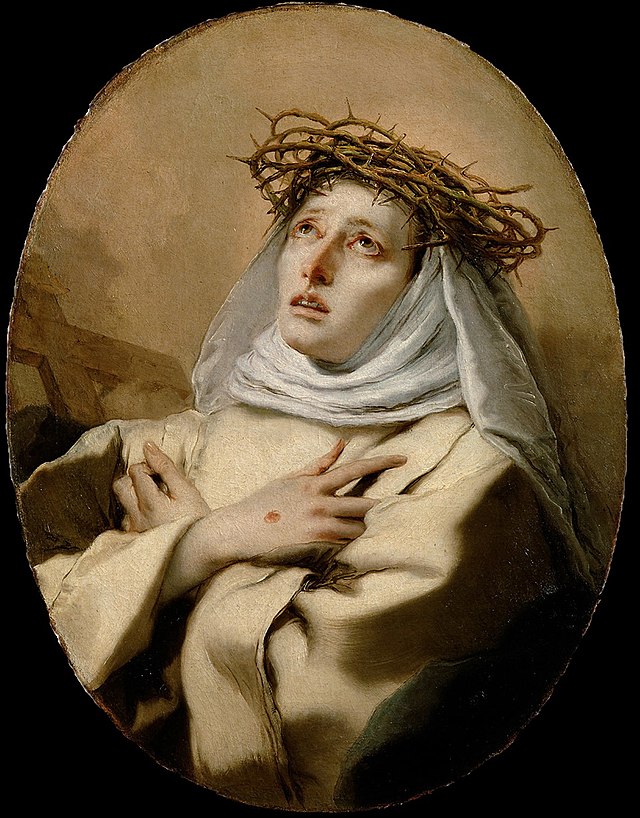
St. Catherine of Siena, born Caterina Benincasa on March 25, 1347, in Siena, Italy, is one of the most revered saints in the Roman Catholic Church. As a theologian, mystic, and activist, she left an indelible mark on both religious and secular history. Her life was a remarkable journey of faith, perseverance, and unwavering commitment to her spiritual beliefs. This article explores the life, influence, and legacy of St. Catherine of Siena, a figure who continues to inspire countless individuals around the world.
Early Life and Spiritual Awakening
Catherine was born into a large family, the 23rd child of Jacopo Benincasa, a prosperous dyer, and his wife Lapa Piagenti. Growing up in the bustling neighborhood of Fontebranda, in the heart of Siena’s contrada dell’Oca, Catherine’s childhood was far from ordinary. Even from a young age, she exhibited signs of deep spirituality, claiming to have had visions of Christ at the tender age of six. According to tradition, she saw Jesus seated on a throne, dressed in pontifical robes, accompanied by the saints Peter, Paul, and John.
This early vision set the tone for Catherine’s life. At the age of seven, she made a vow of perpetual virginity, an extraordinary commitment for a child. Her parents, unaware of the depth of her religious convictions, attempted to arrange a marriage for her when she reached adolescence. However, Catherine resisted these efforts vehemently. In a dramatic gesture, she cut off her hair, covered her head with a veil, and isolated herself in her home, dedicating herself to prayer and fasting.
Her determination and piety eventually won her father’s respect, particularly after he witnessed a mystical event: a dove appeared to descend upon her head while she was in deep prayer. This convinced her family that her religious fervor was not mere youthful enthusiasm but a genuine spiritual calling.
Entering Religious Life
At sixteen, after receiving a vision of St. Dominic, Catherine joined the Dominican Third Order, known as the Mantellate, which allowed her to live a religious life while remaining at home. Despite being semi-literate, she devoted herself to learning, praying for the ability to read so she could better understand the Divine Office and other religious texts. Remarkably, she claimed that her prayers were answered, and she began to read with ease.
Catherine’s commitment to her faith extended beyond her personal devotion. She began to care for the sick and the poor, particularly those suffering from leprosy and other disfiguring diseases. Although initially repulsed by the sight and smell of the sick, Catherine practiced extreme acts of penance to overcome her aversion. In one particularly famous episode, she drank the water used to wash a leper’s sores, declaring it to be the sweetest drink she had ever tasted. This act of profound humility and sacrifice symbolized her complete dedication to God and the suffering of others.
Mystical Experiences and Spiritual Influence
Catherine’s life was marked by numerous mystical experiences, which contributed significantly to her growing reputation as a holy woman. At the age of twenty, she began to experience visions more frequently, and in 1367, she reported receiving a mystical marriage to Christ. In this vision, Jesus appeared to her, accompanied by the Virgin Mary and a host of saints, and placed a ring on her finger, signifying their spiritual union. This ring, visible only to Catherine, remained with her for the rest of her life.
In another powerful vision, Christ removed her heart and replaced it with His own, a symbolic gesture indicating her complete unity with Him. It is said that Catherine bore a scar on her chest for the rest of her life, a physical manifestation of this mystical experience.
As Catherine’s fame as a mystic grew, so did her following. A group of disciples, known as the “Caterinati,” began to gather around her. These followers included both clergy and laypeople, who were drawn to her teachings and her intense spiritual presence. However, her increasing influence also attracted scrutiny from church authorities. The Dominican Order subjected her to an examination to verify the orthodoxy of her teachings. Catherine passed this examination with flying colors, and the order appointed Raymond of Capua as her spiritual director, who would later become her biographer and an important figure in promoting her canonization.
Political and Religious Activism
Catherine’s influence extended beyond the religious sphere into the political arena. In 1375, she was tasked by Pope Gregory XI to promote the crusade in Pisa, a mission that marked the beginning of her active involvement in church politics. During this time, Catherine claimed to have received the stigmata while praying in a small church in Pisa, although, like her mystical ring, these wounds were visible only to her.
One of Catherine’s most significant political achievements was her role in persuading Pope Gregory XI to return the papacy from Avignon, France, to Rome. The papacy had been in Avignon since 1309, a period known as the Avignon Papacy, and many Italians, including Catherine, believed that the pope’s absence from Rome weakened the Church. In 1376, Catherine traveled to Avignon to meet with the pope, bringing with her a group of disciples, an altar, and three confessors. Her passionate pleas and spiritual authority reportedly convinced Gregory XI to make the historic move back to Rome in 1377.
Catherine’s involvement in church affairs did not end there. She continued to play a critical role during the Great Schism of 1378, a period of division within the Catholic Church that saw the election of rival popes. Catherine staunchly supported Pope Urban VI, who had been elected in Rome, against the French-backed antipope Clement VII, elected in Fondi. She moved to Rome to be closer to Urban VI, offering him her unwavering support and advice during this turbulent time.
Writings and Legacy
Catherine of Siena was not only a mystic and a political actor but also a prolific writer. Despite her lack of formal education, she dictated nearly 400 letters to various religious and secular leaders of her time, including popes, kings, and influential figures. These letters, many of which urged reform and spiritual renewal, are considered significant works of early Italian literature and showcase her eloquence and theological insight.
Her most famous written work is the “Dialogue of Divine Providence,” a spiritual treatise that explores themes of sin, repentance, and God’s infinite love and mercy. The “Dialogue” is considered one of the most important works of Christian mysticism and remains a key text in the study of medieval theology.
Catherine’s writings were instrumental in her canonization and have continued to inspire theologians, scholars, and laypeople for centuries. Her legacy was further solidified when she was declared a Doctor of the Church in 1970 by Pope Paul VI, making her one of the first women to receive this honor.
Death and Canonization
St. Catherine of Siena died on April 29, 1380, at the age of 33—a significant age, as it mirrors the age of Christ at His crucifixion. She passed away in Rome, having exhausted herself in her efforts to support the papacy and bring about peace within the Church. Her body was initially buried at Santa Maria sopra Minerva in Rome, but in a macabre turn of events, her head was later removed and taken to Siena, where it was enshrined in the Basilica of San Domenico.
Catherine was canonized by Pope Pius II in 1461, just 81 years after her death, a testament to her widespread influence and the deep veneration she inspired during her lifetime. She is now considered one of the patron saints of Italy, alongside St. Francis of Assisi, and in 1999, Pope John Paul II declared her one of the patron saints of Europe, recognizing her enduring impact on the continent’s spiritual and cultural heritage.
Artistic Representations and Cultural Impact
The life of St. Catherine of Siena has been a rich source of inspiration for artists throughout the centuries. She is often depicted wearing the black and white habit of the Dominican Order, sometimes with a crown of thorns, holding a lily, a crucifix, or a book—symbols of her purity, faith, and wisdom. Many artists have also depicted her mystical marriage to Christ, distinguishing it from similar representations of St. Catherine of Alexandria by portraying Christ as an adult.
Catherine’s influence extends beyond religious art; her life and writings have been the subject of numerous scholarly studies, theological discussions, and popular biographies. Her legacy is evident in the many institutions, churches, and schools named in her honor around the world.
Conclusion: A Life of Enduring Influence
St. Catherine of Siena’s life is a testament to the power of faith and conviction. Despite the challenges of her time, including societal expectations, political turmoil, and personal hardship, she remained steadfast in her devotion to God and her commitment to the Church. Her legacy continues to inspire people of all backgrounds, offering a model of spiritual leadership, courage, and compassion.
As a saint, mystic, and Doctor of the Church, St. Catherine of Siena’s influence is felt far beyond the borders of Italy, resonating throughout the Catholic Church and across the world. Her life story is not just a reflection of her time but a beacon of enduring faith and moral integrity that continues to guide and inspire generations.


