
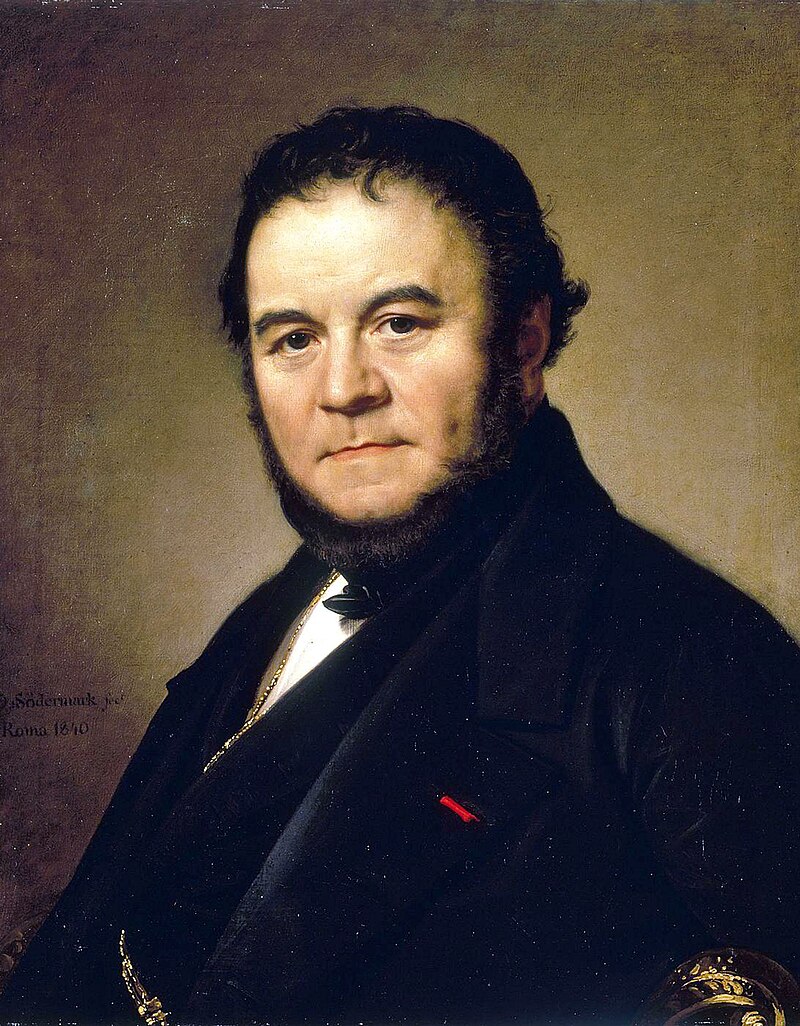
Stendhal, the pen name of Henri Beyle, stands as one of the most influential figures in French literature. Born on January 23, 1783, in Grenoble, France, Stendhal’s life and works reflect the turbulence and transformation of Europe during the late 18th and early 19th centuries. A novelist, biographer, and essayist, Stendhal is best known for his penetrating analysis of the human condition, his pioneering realism, and his exploration of the psychological depth of his characters. His works, particularly The Red and the Black (1830) and The Charterhouse of Parma (1839), have left an indelible mark on the literary world, influencing generations of writers and thinkers.
Early Life: The Formation of a Literary Mind
Henri Beyle was born into a wealthy bourgeois family in Grenoble. The early loss of his mother when he was just seven years old profoundly affected him. His relationship with his father, a conservative and devoutly religious man, was strained, and this tension would shape much of his worldview and later writings. Young Henri was a brilliant student, and despite his father’s hopes that he would pursue a career in law, he was drawn to literature and the arts from an early age.
At sixteen, Beyle moved to Paris with the intention of enrolling at the prestigious École Polytechnique, but he quickly abandoned this plan. Instead, he took up a position at the Ministry of War, thanks to the influence of his cousin Pierre Daru, a high-ranking official. This move marked the beginning of his lifelong association with the military and with Napoleon Bonaparte, whom he greatly admired.
Military Career and Napoleonic Influence
In 1800, Stendhal joined Napoleon’s army in Italy as a sub-lieutenant in the cavalry. This experience ignited his lifelong love affair with Italy, a country he considered his spiritual home. Stendhal’s military career took him across Europe, from Austria to Germany, and from Russia to Italy. During these years, he witnessed firsthand the rise and fall of Napoleon, experiences that would later color his novels with themes of ambition, power, and disillusionment.
Stendhal’s involvement in the Napoleonic Wars was not just a matter of military duty; it was also a source of deep personal and intellectual inspiration. He admired Napoleon for his energy, his modernizing zeal, and his disdain for the old aristocratic order. However, the fall of Napoleon in 1814 forced Stendhal to reassess his ideals. Disillusioned with politics and war, he turned increasingly to literature and the arts as a means of expressing his complex views on society, power, and the individual.
The Italian Interlude: Love, Art, and Exile
After the collapse of the Napoleonic Empire, Stendhal retired from military service and settled in Italy, where he would spend the next seven years. Milan became his base, a city where he immersed himself in the vibrant cultural life, developing a deep appreciation for music, painting, and literature. It was also in Italy that Stendhal experienced his first great love affair with Angiola Pietragrua, a relationship that would have a lasting impact on his writing.
During this period, Stendhal began to forge his identity as a writer. He adopted the pen name “Stendhal,” likely a homage to the German town of Stendal, the birthplace of the art historian Johann Joachim Winckelmann, whom Stendhal admired. His time in Italy was marked by intense intellectual activity, as he wrote prolifically, producing essays on art, music, and literature.
However, Stendhal’s love for Italy was not without its challenges. His unrequited love for Matilde Dembowski, a Milanese noblewoman, left him deeply despondent. Moreover, his suspected involvement with the Carbonari, a secret revolutionary society, led to his being viewed with suspicion by the Austrian authorities. In 1821, under pressure from the authorities and perhaps seeking a fresh start, Stendhal returned to Paris.
Paris and Literary Ascendancy
Returning to Paris, Stendhal found himself in a city that was both exhilarating and challenging. Financially, he was not well-off, and he struggled to maintain the lifestyle of a gentleman while engaging in the Parisian literary scene. To make ends meet, he contributed articles on art and music to various English and French journals, including the Journal de Paris. These articles displayed his keen critical insight and his passion for the arts, but they were not enough to secure a stable income.
It was during this time that Stendhal began to focus more seriously on his literary career. His early works, including On Love (1822) and Racine and Shakespeare (1823), revealed his growing preoccupation with the complexities of human emotions and the conflict between romantic idealism and the harsh realities of life. These themes would come to dominate his later, more mature works.
Stendhal’s first major novel, Armance (1827), was met with limited success, but it was a crucial step in his development as a novelist. It was followed by Vanina Vanini (1829), a short story that further explored the themes of love, power, and rebellion. These early works laid the groundwork for the masterpieces that would soon follow.
The Masterpieces: The Red and the Black and The Charterhouse of Parma
The year 1830 marked the publication of Stendhal’s most famous novel, The Red and the Black (Le Rouge et le Noir). This novel, set against the backdrop of the post-Napoleonic Restoration, tells the story of Julien Sorel, a young man of humble origins who aspires to rise in society through a combination of ambition, cunning, and romantic entanglements. The novel is a searing critique of the hypocrisy and corruption of the French aristocracy and the Catholic Church, as well as a psychological portrait of a young man caught between the conflicting forces of passion and ambition.
The Red and the Black is often regarded as one of the first works of literary realism. Stendhal’s portrayal of Julien Sorel as a complex, multifaceted character, driven by both noble aspirations and base desires, broke new ground in the depiction of human psychology in literature. The novel’s blend of social commentary, psychological insight, and narrative innovation has earned it a place among the great works of Western literature.
Stendhal’s other major novel, The Charterhouse of Parma (La Chartreuse de Parme), published in 1839, is equally celebrated. This novel, set in Italy during the Napoleonic Wars, follows the life of Fabrice del Dongo, a young nobleman who becomes embroiled in political intrigue and romantic escapades. Like The Red and the Black, The Charterhouse of Parma is notable for its vivid characterizations, its exploration of political and social issues, and its sophisticated narrative structure.
The Charterhouse of Parma is also a reflection of Stendhal’s enduring love for Italy. The novel’s depiction of the Italian court, with its blend of grandeur, decadence, and intrigue, is both a tribute to and a critique of the society that Stendhal had come to know so well. The novel’s final chapters, which describe Fabrice’s retreat to a life of contemplation in a remote monastery, can be seen as a meditation on the futility of worldly ambition and the search for spiritual peace.
Later Years and Legacy
In 1830, following the July Revolution and the rise of Louis-Philippe to power, Stendhal was appointed as the French consul in Trieste. However, due to Austrian opposition, he was instead posted to Civitavecchia, a small port town in the Papal States. This position, while providing a steady income and a measure of security, also left Stendhal with a great deal of free time, which he devoted to writing and traveling.
Stendhal’s later years were marked by declining health, but also by continued literary productivity. He wrote several more novels, essays, and travel writings, though none achieved the acclaim of his earlier works. In 1841, he took a leave of absence from his consular duties due to his worsening health and returned to Paris. A year later, on March 23, 1842, Stendhal died suddenly of a stroke at the age of 59.
Despite his relatively modest reputation during his lifetime, Stendhal’s posthumous influence has been immense. He is often considered a precursor to the great realist novelists of the 19th century, such as Gustave Flaubert and Honoré de Balzac. His works, particularly The Red and the Black and The Charterhouse of Parma, are now regarded as masterpieces of world literature, celebrated for their psychological depth, narrative complexity, and unflinching exploration of the human condition.
Conclusion
Stendhal’s life and works represent a unique blend of romantic idealism and realist precision. His novels, rich with psychological insight and social commentary, continue to resonate with readers today. As a writer, he was ahead of his time, laying the groundwork for the development of the modern novel. As a man, he lived a life marked by passion, ambition, and a relentless pursuit of truth, both in his art and in his personal life.
Stendhal’s legacy is that of a pioneer, a writer who dared to explore the complexities of the human soul and the intricacies of society with a clarity and honesty that few have matched. His works remain essential reading for anyone interested in the development of the novel and the exploration of the human psyche.


