
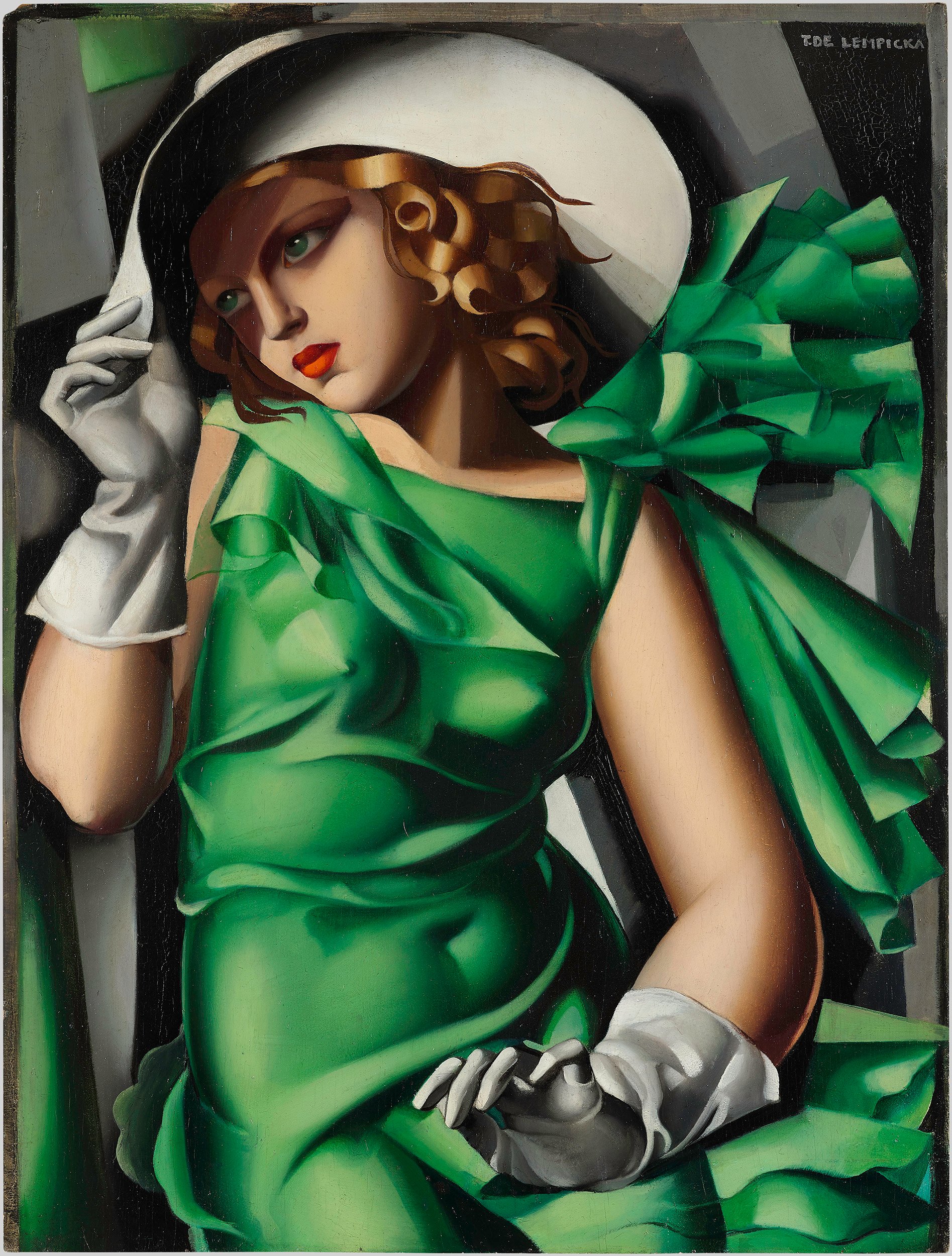
Tamara de Lempicka, born as Tamara Rosalia Gurwik-Gorska on June 16, 1894, is an iconic figure in the world of art. Known for her distinctive Art Deco style, she was more than just a painter; she was a symbol of modernity, luxury, and the avant-garde spirit of the early 20th century. This article delves into the life, fame, and significant milestones of Tamara de Lempicka, providing a comprehensive overview of her journey as an artist, her influence on art history, and her legacy.
Early Life and Background
Tamara de Lempicka’s origins are somewhat shrouded in mystery, with various accounts suggesting she was born either in Warsaw, Poland, or Moscow, Russia. Regardless of her exact birthplace, what is clear is that she was born into a wealthy and cultured family, which allowed her to pursue her interests in art and travel from a young age.
In 1911, at the age of 17, Tamara embarked on a life-changing trip to Italy with her grandmother. It was during this journey that she discovered her passion for art, a passion that would define her life. The Renaissance masterpieces she encountered in Italy left a profound impression on her, igniting a desire to create art that was both beautiful and bold.
The Move to St. Petersburg and Marriage
In 1914, Tamara moved to St. Petersburg, disobeying her parents’ wishes. She went to live with her wealthy aunt, Stefa Jansen, who introduced her to the glamorous social circles of the Russian elite. It was at one of these lavish parties that Tamara met Tadeusz Lempicki, a young and handsome Polish lawyer. The two quickly fell in love and married in 1916, just before the Russian Revolution turned their world upside down.
The revolution had a profound impact on Tamara and her family. Tadeusz was arrested for his counter-revolutionary activities, and it was only through Tamara’s connections and relentless efforts that he was eventually released. The couple fled Russia, first to Copenhagen and then to Paris, where they hoped to rebuild their lives.
Paris and the Birth of an Artistic Career
Arriving in Paris in 1920, Tamara and Tadeusz were faced with the harsh realities of exile. Paris, however, offered Tamara the opportunity to pursue her passion for art. With the birth of her daughter, Kizette, and the financial pressure of supporting her family, Tamara decided to dedicate herself fully to painting.
She enrolled at the Académie de la Grande Chaumière and studied under Maurice Denis and André Lhote, two prominent figures in the Parisian art scene. Lhote, in particular, had a significant influence on Tamara’s style, helping her develop the sharp, geometric lines and cool elegance that would become her signature.
By 1922, Tamara de Lempicka had her first major breakthrough when she exhibited her work at the Salon d’Automne. The exhibition marked the beginning of her rise to fame in the Paris art world. Her paintings, characterized by their sleek, stylized forms and vibrant colors, stood out in a city brimming with artistic innovation. She quickly became a sought-after portraitist, known for her ability to capture the glamour and sophistication of the interwar elite.
Art Deco Icon and the Height of Fame
The 1920s and 1930s were the golden years of Tamara de Lempicka’s career. Her art perfectly embodied the spirit of the Art Deco movement, which was characterized by its embrace of modernity, luxury, and a certain sense of hedonism. Lempicka’s portraits of aristocrats, artists, and socialites were imbued with an air of decadence, reflecting the opulent lifestyles of her subjects.
One of her most famous works from this period is the 1925 Self-Portrait (Tamara in a Green Bugatti), which has become an iconic image of female independence and empowerment. In the painting, Tamara depicts herself as a modern woman: glamorous, confident, and in control. The sleek lines of the green Bugatti, coupled with her cool, composed expression, make this painting a quintessential example of Art Deco aesthetics.
Tamara’s success was not just confined to France. She traveled extensively across Europe, exhibiting her work in major cities and attracting the attention of art collectors and critics alike. In 1925, she traveled to Italy with her mother and daughter to study the classical masters. During this trip, she met the Italian poet and nationalist Gabriele D’Annunzio, who was captivated by her beauty and talent. Although their relationship was more flirtatious than professional, it added to the mythos surrounding her persona.
Personal Life and Romantic Entanglements
Tamara de Lempicka’s personal life was as colorful and complex as her paintings. Her marriage to Tadeusz Lempicki began to unravel in the late 1920s, as she became more successful and independent. The couple divorced in 1928, and soon after, Tamara became involved with Baron Raoul Kuffner, a wealthy Hungarian art collector.
Kuffner, who would later become her second husband in 1933, was not only a romantic partner but also a significant patron of her work. Their relationship allowed Tamara to continue living in the style to which she had become accustomed, even as the world around her changed dramatically with the onset of the Great Depression and the rise of fascism in Europe.
Tamara’s personal life was also marked by her bisexuality, a fact she did not attempt to hide. She had numerous relationships with both men and women, often with other artists and members of the avant-garde. This aspect of her life added to her allure and mystique, making her a figure of fascination in the bohemian circles of Paris.
The Move to America and Later Years
As Europe descended into chaos in the late 1930s, Tamara and Raoul Kuffner decided to leave Paris for the United States. They settled in New York in 1939, where Tamara continued to paint and exhibit her work. Her style, however, began to change during this period. The exuberance of her earlier work gave way to more somber and abstract compositions, reflecting the dark mood of the time.
Despite her continued efforts, Tamara’s work in the 1940s and 1950s did not achieve the same level of acclaim as her earlier pieces. The art world was changing, and the rise of Abstract Expressionism made her stylized, figurative approach seem out of step with contemporary trends. Nevertheless, she remained active, exhibiting her work in New York, Los Angeles, and San Francisco.
In 1962, following the death of her husband, Tamara left New York and moved to Houston, Texas, to be closer to her daughter, Kizette. By this time, she had largely retreated from the public eye, though she continued to paint. A retrospective of her work held in 1972 at the Galerie du Luxembourg in Paris brought her some renewed attention, but it was clear that her era of peak fame had passed.
Legacy and Revival of Interest
Tamara de Lempicka passed away on March 18, 1980, in Cuernavaca, Mexico, where she had moved in her later years. As per her wishes, her ashes were scattered over the volcano Popocatépetl. For many years after her death, her work was largely forgotten by the mainstream art world. However, starting in the 1990s, there was a significant revival of interest in her art, spurred by the renewed appreciation of Art Deco and its aesthetic.
Today, Tamara de Lempicka is celebrated as one of the most important artists of the Art Deco movement. Her paintings, once dismissed as relics of a bygone era, are now highly sought after by collectors and have been featured in major exhibitions around the world. Celebrities and fashion icons, drawn to her glamorous style and the powerful femininity of her work, have further popularized her art, making her a symbol of timeless elegance.
Lempicka’s work is often associated with themes of female empowerment, sexuality, and modernity. Her portraits of strong, independent women continue to resonate in contemporary culture, and her influence can be seen in everything from fashion to advertising. Tamara de Lempicka’s legacy is a testament to her ability to capture the spirit of her time while also transcending it, creating art that remains relevant and compelling to this day.
Conclusion
Tamara de Lempicka’s life and work reflect the complexities and contradictions of the 20th century. She was a woman who defied conventions, both in her art and in her personal life, and who created a body of work that continues to captivate audiences with its beauty, boldness, and elegance. Her legacy as an artist is firmly established, but more than that, she remains a cultural icon—a symbol of the power and allure of modern femininity.
As we look back on her life and career, Tamara de Lempicka stands out not only for her contributions to the Art Deco movement but also for her role in shaping the visual culture of her time. Her paintings are more than just works of art; they are windows into an era of glamour, sophistication, and change. And as interest in her work continues to grow, Tamara de Lempicka’s influence on art and culture shows no signs of fading.


