
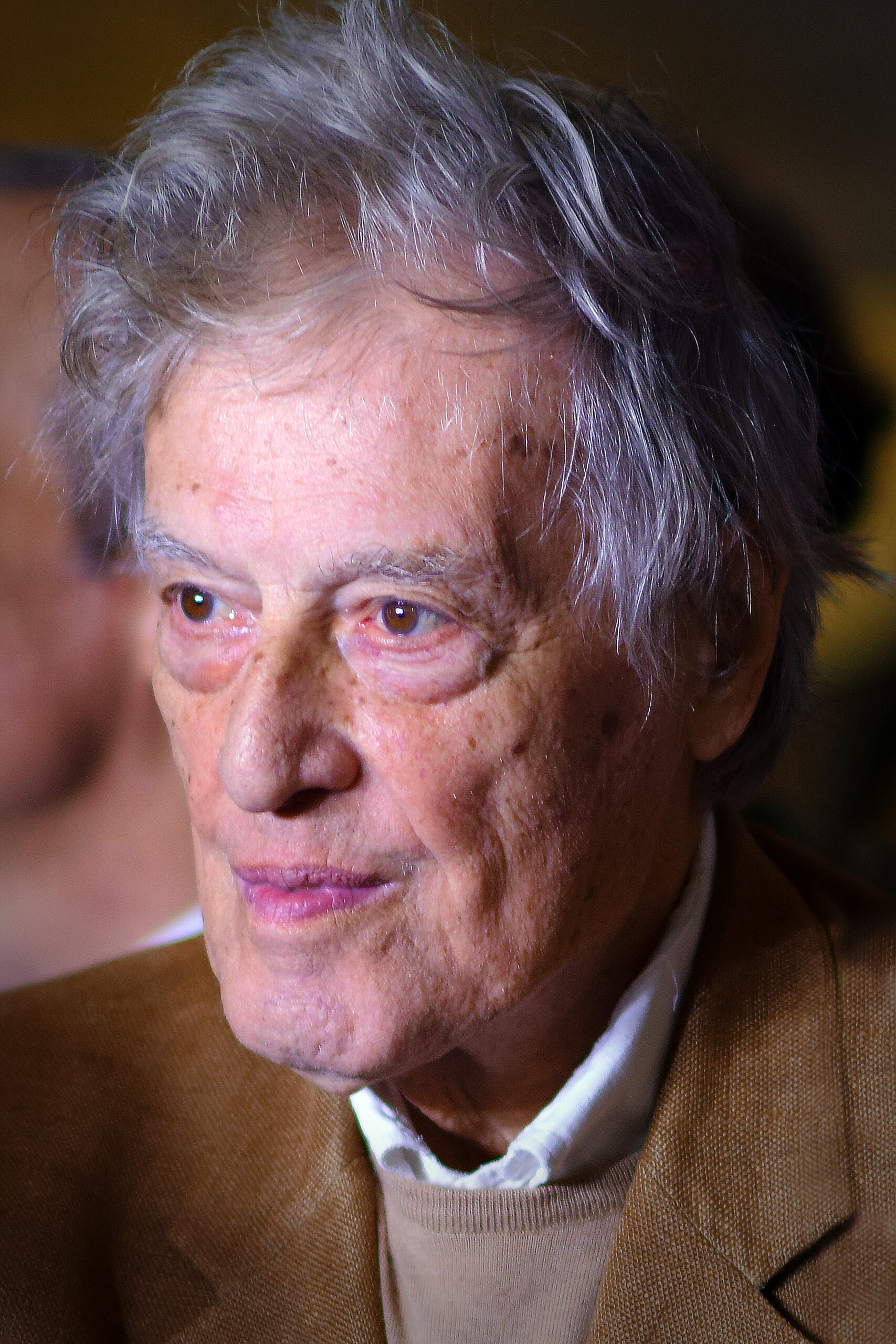
Tom Stoppard, born as Tomas Straussler on July 3, 1937, in Zlín, Czechoslovakia, is one of the most celebrated playwrights of the modern era. His journey from a war-torn Europe to the pinnacle of British theater is a testament to his resilience, talent, and the profound impact of his life experiences on his work.
Early Life and Background
Tom Stoppard was born into a Jewish family at a time when Europe was on the brink of World War II. To escape the horrors of the Holocaust, his family fled Czechoslovakia, first moving to Singapore and then to India, where young Tom received a British-style education. Tragically, during this period of upheaval, Stoppard’s father was killed. His mother later remarried, and Tom took the surname of his stepfather, Kenneth Stoppard, a British army major.
In 1946, the Stoppard family relocated to England, where Tom began to lay the foundations for what would become an illustrious career. He left school at the age of 17 to pursue journalism, a move that would eventually lead him to the world of theater.
The Genesis of a Playwright
Stoppard’s first play, A Walk on the Water (later renamed Enter a Free Man), was completed in 1960, marking the beginning of his foray into drama. However, it was in 1967 that he truly made his mark with Rosencrantz and Guildenstern Are Dead. This tragicomedy, which offers a unique perspective on the minor characters from Shakespeare’s Hamlet, was a resounding success, catapulting Stoppard to fame. The play was later adapted into a film in 1990, for which Stoppard himself directed and won the prestigious Golden Lion at the Venice Film Festival.
Rosencrantz and Guildenstern Are Dead is emblematic of Stoppard’s style—witty, intellectually rigorous, and often characterized by a deep engagement with philosophical ideas. The play’s exploration of fate, free will, and the nature of existence resonated with audiences and critics alike, establishing Stoppard as a leading figure in contemporary theater.
A Multifaceted Career
Stoppard’s work is distinguished by its variety and depth. His plays often blend elements of comedy and tragedy, offering audiences both entertainment and intellectual stimulation. For instance, The Real Inspector Hound (1968) is a satirical take on the detective genre, where two theater critics find themselves inadvertently involved in the murder mystery they are reviewing.
Another notable work is Jumpers (1972), a play that delves into the philosophical debate between logical positivism and moral relativism, set against the backdrop of a bizarre circus of acrobats and philosophers. This play, like much of Stoppard’s work, is a testament to his ability to weave complex ideas into engaging narratives.
Stoppard’s interest in politics and human rights also found expression in his work. In the 1970s, he became increasingly involved in advocating for political dissidents in Eastern Europe, particularly in the Soviet Union. This activism is reflected in plays like Every Good Boy Deserves Favour (1977), which critiques the use of psychiatry to silence political dissent.
His 1982 play The Real Thing examines the nature of love and fidelity, using the device of a play within a play to blur the lines between reality and fiction. This work, which won multiple awards, is often regarded as one of his most accomplished plays, showcasing his command of language and structure.
Later Work and Continued Influence
Throughout the 1980s and 1990s, Stoppard continued to produce acclaimed works. Arcadia (1993), for example, is a richly layered play that juxtaposes themes of chaos theory, landscape gardening, and Romantic literature across two timelines. This play is frequently cited as one of his masterpieces, admired for its intricate plotting and profound insights into the nature of knowledge and time.
Stoppard’s work extends beyond the theater. He has written extensively for radio, television, and film. His screenplay for Shakespeare in Love (1998) won an Academy Award and brought him widespread recognition beyond the theater world. The film, a romantic comedy set in the Elizabethan era, is a playful and affectionate homage to the Bard, showcasing Stoppard’s deep love of literature and history.
In addition to Shakespeare in Love, Stoppard contributed to the screenplays of several other notable films, including Brazil (1985), Empire of the Sun (1987), and Enigma (2001). His versatility as a writer is evident in his ability to move seamlessly between different genres and mediums, always bringing his signature wit and intelligence to his work.
Stoppard’s Personal Life and Legacy
Tom Stoppard has been married twice, first to Jose Ingle from 1965 to 1972, and then to Miriam Moore-Robinson from 1972 to 1992. He has two sons, including Ed Stoppard, who has followed in his father’s footsteps and become an actor.
Stoppard’s life and career are marked by a relentless curiosity and a deep engagement with the world around him. His work reflects a wide range of influences, from philosophy and science to history and politics. He belongs to a generation of British playwrights who, beginning in the late 1960s, revolutionized the theater with their innovative approaches to storytelling and their willingness to tackle complex and challenging subjects.
The Historical Context of Stoppard’s Work
Stoppard’s rise to prominence in the 1960s and 1970s coincided with a period of significant social and political change in Britain. The country was grappling with the aftermath of World War II, the decline of the British Empire, and the cultural upheavals of the 1960s. In this context, Stoppard’s work can be seen as part of a broader movement of British playwrights who sought to challenge traditional forms of theater and explore new ways of telling stories.
Stoppard was also influenced by the European avant-garde, particularly the Theater of the Absurd, which rejected conventional narrative structures in favor of more experimental forms of storytelling. This influence is evident in plays like After Magritte (1971), which plays with the conventions of surrealism, and Travesties (1974), a farcical exploration of art and politics that features historical figures like James Joyce and Lenin.
Stoppard’s interest in language and its limitations is another hallmark of his work. In plays like Dogg’s Hamlet, Cahoot’s Macbeth (1979), he experiments with the idea of language as a barrier to communication, creating a fictional language, “Dogg,” that sounds like English but has entirely different meanings. This play, like much of his work, reflects Stoppard’s fascination with the ways in which language can both connect and divide us.
The Legacy of Tom Stoppard
Tom Stoppard’s influence on contemporary theater cannot be overstated. His work has inspired generations of playwrights and continues to be performed and studied around the world. His ability to blend humor with serious philosophical inquiry has made him a unique and enduring voice in the world of drama.
In recognition of his contributions to theater, Stoppard has received numerous awards and honors, including a knighthood in 1997 and the Order of Merit in 2000. His work continues to be celebrated for its wit, intelligence, and emotional depth.
As of today, Tom Stoppard remains an active and influential figure in the world of theater. His most recent play, Leopoldstadt (2020), is a poignant exploration of Jewish identity and the impact of the Holocaust on European Jewry, drawing on his own family’s history. The play has been widely acclaimed, reaffirming Stoppard’s place as one of the greatest playwrights of our time.
In conclusion, Tom Stoppard’s life and work are a testament to the power of art to engage with the most profound questions of human existence. From his early days as a refugee fleeing war-torn Europe to his current status as a revered elder statesman of the theater, Stoppard’s journey is a remarkable story of creativity, resilience, and intellectual rigor. His plays, with their unique blend of humor, pathos, and philosophical depth, will undoubtedly continue to be celebrated for generations to come.


