
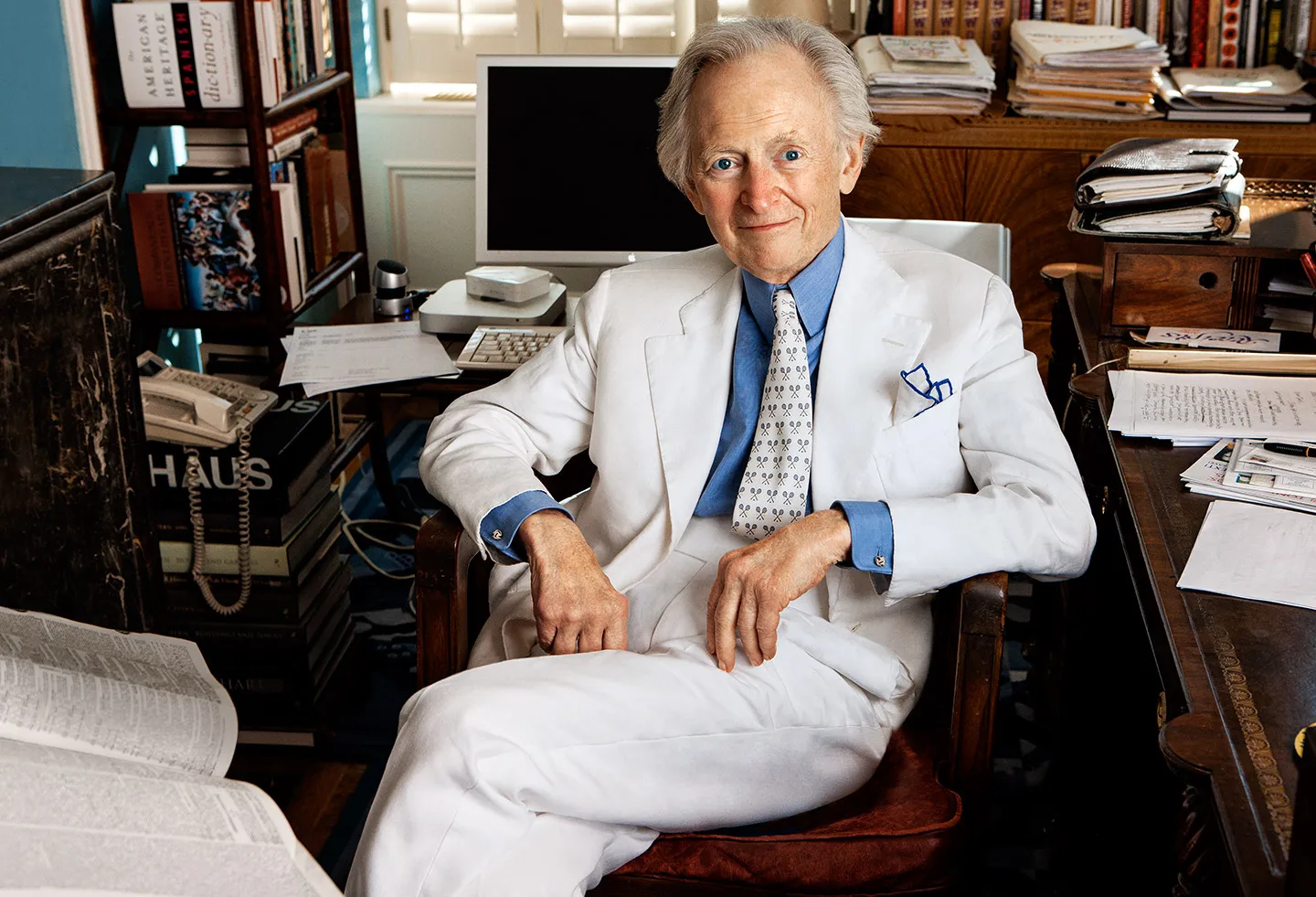
Tom Wolfe, born Thomas Kennerly Wolfe Jr. on March 2, 1931, in Richmond, Virginia, was an American journalist, author, and critic who left an indelible mark on the world of literature and journalism. Known for his distinctive style, both in writing and in his sartorial choices, Wolfe was a pioneering figure in the development of “New Journalism,” a genre that blended literary techniques with traditional reporting. This article explores the life, fame, and highlights of Tom Wolfe’s illustrious career, offering detailed insights into his contributions to literature and journalism.
Early Life and Education: The Making of a Literary Icon
Tom Wolfe was born into a well-to-do Southern family in Richmond, Virginia. His father, Thomas Kennerly Wolfe Sr., was an agronomist and editor of The Southern Planter, a farming trade journal, while his mother, Louise, was a lively socialite. Wolfe grew up in the affluent Sherwood Park neighborhood, where he was known for his sharp intellect and his love for writing.
Wolfe attended the St. Christopher’s School, an Episcopal boys’ school in Richmond, where he excelled academically and showed early promise as a writer. He was the editor of the school newspaper and a star baseball player, a sport he pursued passionately throughout his youth. After graduating in 1949, Wolfe turned down an offer from Princeton University to attend Washington and Lee University, a decision that would shape his future as a writer.
At Washington and Lee, Wolfe majored in English and became deeply involved in the university’s literary community. He was a member of the Phi Kappa Sigma fraternity and co-founded the university’s literary magazine, Shenandoah. His time at Washington and Lee was formative, as he honed his writing skills and developed a keen interest in American culture, a theme that would dominate much of his later work.
In 1951, Wolfe graduated cum laude with a thesis titled “A Zoo Full of Zebras: Anti-Intellectualism in America,” which reflected his early critique of cultural trends. Despite his success as a student, Wolfe’s passion for baseball remained strong, and he briefly pursued a career in professional baseball, trying out for the New York Giants in 1952. However, after three days, he was cut from the team, prompting him to focus on his literary ambitions.
The Birth of a Journalist: Early Career and the Road to New Journalism
After his baseball dreams were dashed, Wolfe decided to pursue a career in academia. He was accepted into the American Studies doctoral program at Yale University, where he continued to explore his interest in American culture. However, academia proved too stifling for Wolfe’s restless spirit, and he soon found himself drawn to the fast-paced world of journalism.
In 1956, while still working on his PhD, Wolfe accepted a position as a reporter for The Springfield Union in Massachusetts. This job marked the beginning of his journalism career, which would later redefine the boundaries of the profession. Wolfe completed his doctoral thesis, titled “The League of American Writers: Communist Organizational Activity Among American Writers, 1929-1942,” in 1957, but chose not to pursue a career in academia.
Wolfe’s time at The Springfield Union was followed by a stint at The Washington Post, where he honed his skills as a journalist. His coverage of the Cuban Revolution in 1961 earned him the Newspaper Guild’s prestigious award for foreign reporting. However, it was not just his ability to report on international events that set Wolfe apart; it was his distinctive voice, characterized by a flair for the dramatic and an eye for the absurd, that began to emerge during this period.
In 1962, Wolfe moved to New York City to work for the New York Herald Tribune. It was here, amidst the vibrant cultural scene of the 1960s, that Wolfe would begin to develop the style that would make him famous. His work at the Herald Tribune coincided with a newspaper strike, which led Wolfe to freelance for magazines like Esquire. One of his first major pieces for Esquire was an article on the Southern California car culture, which was published in 1964 under the title “There Goes (Varoom! Varoom!) That Kandy-Kolored Tangerine-Flake Streamline Baby.”
This article marked the beginning of Wolfe’s foray into what would later be known as “New Journalism.” This style of journalism broke away from traditional reporting by incorporating literary techniques such as scene-setting, dialogue, and subjective perspectives. Wolfe’s ability to blend factual reporting with a novelistic approach allowed him to capture the essence of the 1960s counterculture, making him a key figure in the literary landscape of the time.
The Rise of New Journalism: Literary Innovation and Cultural Commentary
Tom Wolfe’s work in the 1960s and 1970s established him as a leading figure in the New Journalism movement. This movement, which included other notable writers like Truman Capote, Joan Didion, Hunter S. Thompson, and Gay Talese, sought to push the boundaries of traditional journalism by blending it with fiction techniques. Wolfe’s innovative approach was characterized by his vivid descriptions, his use of onomatopoeia, and his ability to capture the zeitgeist of American culture.
One of Wolfe’s most famous works from this period is The Electric Kool-Aid Acid Test (1968), a non-fiction book that chronicles the adventures of Ken Kesey and his band of Merry Pranksters as they embark on a cross-country road trip in a brightly painted bus. The book is a quintessential example of New Journalism, combining immersive reporting with Wolfe’s signature style. The Electric Kool-Aid Acid Test is not just a document of the 1960s counterculture; it is a literary work that captures the spirit of an era, with its emphasis on experimentation, freedom, and rebellion.
Wolfe continued to produce influential works throughout the 1970s, including Radical Chic & Mau-Mauing the Flak Catchers (1970), a collection of essays that satirizes the pretensions of Manhattan’s liberal elite and their flirtations with radical politics. The title essay, “Radical Chic,” dissects a fundraising party thrown by conductor Leonard Bernstein for the Black Panthers, exposing the contradictions and superficiality of high-society activism.
Another significant work from this period is The Right Stuff (1979), a book that explores the lives of test pilots and astronauts involved in the U.S. space program. Wolfe’s ability to delve into the psychology of his subjects, combined with his detailed reporting, made The Right Stuff a critical and commercial success. The book won numerous awards and was later adapted into an acclaimed film in 1983.
The Move to Fiction: The Bonfire of the Vanities and Beyond
By the 1980s, Tom Wolfe had established himself as one of the most prominent writers in America. However, he was not content to rest on his laurels. Wolfe made a bold move into fiction with the publication of his first novel, The Bonfire of the Vanities (1987). This sprawling social satire, set in New York City, explores themes of greed, ambition, and social stratification in the go-go 1980s. The novel follows Sherman McCoy, a wealthy bond trader whose life unravels after a car accident in the Bronx sets off a chain of events that exposes the racial and class tensions simmering beneath the surface of Manhattan society.
The Bonfire of the Vanities was both a critical and commercial success, cementing Wolfe’s reputation as a master storyteller. The novel’s incisive commentary on the excesses of Wall Street and the media’s role in shaping public opinion resonated with readers and critics alike. Wolfe’s ability to capture the zeitgeist of the 1980s, much as he had done with the 1960s counterculture, demonstrated his versatility as a writer and his keen understanding of American society.
Wolfe continued to write fiction throughout the 1990s and 2000s, producing novels like A Man in Full (1998), which explores the lives of two men in Atlanta—one a real estate mogul facing financial ruin, and the other an imprisoned convict seeking redemption. The novel delves into themes of power, race, and the American dream, and it was praised for its rich character development and social commentary.
In 2004, Wolfe published I Am Charlotte Simmons, a novel that takes a critical look at the culture of American higher education. The book follows the experiences of Charlotte Simmons, a naive freshman at an elite university, as she navigates the challenges of college life, including peer pressure, academic competition, and sexual politics. Although the novel received mixed reviews, it showcased Wolfe’s continued interest in exploring the complexities of American society.
Legacy and Influence: Tom Wolfe’s Enduring Impact on American Literature
Tom Wolfe’s influence on American literature and journalism is profound. He is often credited with helping to redefine the role of the journalist, transforming it from a mere recorder of facts to a storyteller who could capture the essence of a moment, a movement, or an entire era. His work in New Journalism opened the door for future generations of writers to experiment with style, voice, and narrative structure in their reporting.
Wolfe’s impact extended beyond the realm of journalism. His novels, particularly The Bonfire of the Vanities, have become essential reading for anyone seeking to understand the social and cultural dynamics of late 20th-century America. His ability to satirize the follies of the rich and powerful, while also providing a sympathetic portrayal of those caught in the crossfire, made his work both entertaining and thought-provoking.
Wolfe’s writing style, characterized by its exuberance, attention to detail, and use of literary devices, set him apart from his contemporaries. His work is often described as both flamboyant and meticulous, combining a deep understanding of human nature with a keen eye for the absurd. Whether writing about astronauts, Wall Street bankers, or college students, Wolfe brought the same level of intensity and insight to his subjects.
Personal Life and Final Years: A Writer to the End
Tom Wolfe’s personal life was as colorful as his writing. Known for his trademark white suits, Wolfe cultivated a public persona that was both eccentric and distinguished. He married Sheila Berger in 1978, and the couple had two children, Alexandra and Tommy. Wolfe was a devoted family man, and his home life provided a stable foundation for his prolific writing career.
Wolfe continued to write and publish well into his later years. His final novel, Back to Blood (2012), explores the cultural and racial tensions in Miami, Florida, providing a fitting capstone to a career spent dissecting the intricacies of American society. The novel received praise for its lively prose and its unflinching examination of contemporary issues.
Tom Wolfe passed away on May 14, 2018, at the age of 87, due to complications from an infection. His death marked the end of an era in American literature, but his legacy lives on through his body of work and the countless writers he inspired.
Conclusion: The Enduring Legacy of Tom Wolfe
Tom Wolfe was a writer who defied categorization. Whether as a journalist, novelist, or critic, he approached his subjects with a unique blend of curiosity, skepticism, and wit. His contributions to literature and journalism have left an indelible mark on both fields, and his influence can still be seen in the work of contemporary writers who continue to push the boundaries of narrative non-fiction.
Wolfe’s legacy is one of innovation and fearlessness. He was never content to follow the trends of the day, instead choosing to carve out his own path and challenge the conventions of the literary world. In doing so, he created a body of work that remains as relevant and engaging today as it was when it was first published.
Tom Wolfe’s life and career serve as a testament to the power of the written word and the enduring importance of storytelling. He was a writer who captured the spirit of his times, and in doing so, he ensured that his work would continue to resonate with readers for generations to come.


