
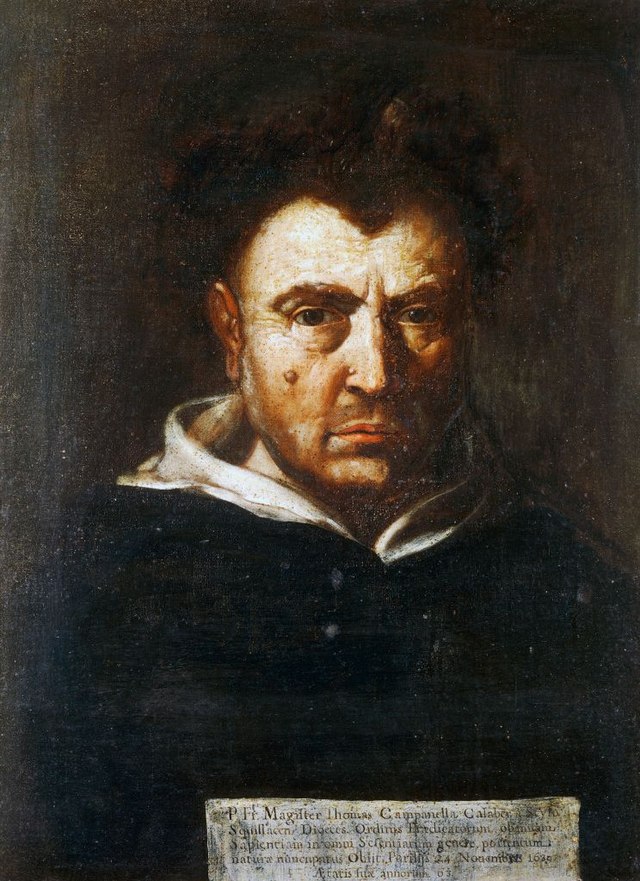
Tommaso Campanella is a towering figure in the annals of philosophy, best known for his visionary works and revolutionary ideas that bridged the gap between the medieval and modern eras. Born on September 5, 1568, in Stilo, Calabria, Campanella’s life was marked by a series of dramatic events, intellectual pursuits, and bold defiance against the established order. His contributions to philosophy, particularly his utopian vision and critique of political and religious orthodoxy, continue to be subjects of deep interest and study.
Early Life and Entry into Religious Orders
Campanella was born Giovanni Domenico Campanella to a poor and uneducated shoemaker. Despite his humble beginnings, he exhibited prodigious intellectual abilities from a young age. At just thirteen, he entered the Dominican order, taking the name Tommaso in honor of Saint Thomas Aquinas. This early entry into religious life set the stage for his future intellectual endeavors, but it also placed him on a collision course with the dominant religious and political authorities of his time.
His studies within the Dominican order were rigorous, and he soon became well-versed in the teachings of classical philosophers and theologians. However, Campanella’s intellectual curiosity extended beyond the approved curriculum. He clandestinely read the works of Erasmus, Marsilio Ficino, and Bernardino Telesio, among others, which profoundly influenced his thinking. These early influences were instrumental in shaping his philosophical outlook, particularly his ideas about nature, society, and the cosmos.
Defiance and Persecution
Campanella’s unorthodox views and his interest in esoteric knowledge soon drew the ire of the religious authorities. His ideas about religion and his fascination with magical arts were deemed heretical, leading to his first encounter with the Inquisition. Fleeing from Naples, where he had been studying under Giovanni Battista della Porta, Campanella sought refuge in various cities, including Rome, Florence, and Padua. It was in Padua that he came into contact with Galileo Galilei, whose work and ideas he greatly admired.
Despite his efforts to evade the authorities, Campanella was eventually arrested and imprisoned on charges of heresy. However, this did not deter him. Upon his release, he returned to his native Calabria, where he became involved in a conspiracy to overthrow Spanish rule and establish a new religious order. This bold but ill-fated attempt resulted in his arrest and subsequent imprisonment. To avoid execution, Campanella feigned madness, a tactic that allowed him to escape the worst of the Inquisition’s wrath.
The Philosopher in Chains
Campanella spent the next twenty-seven years of his life in various prisons, primarily in Naples. These were years of intense intellectual activity, during which he produced some of his most significant works. His imprisonment did not stifle his creative spirit; rather, it seemed to fuel it. Among the many works he penned during this period was a treatise dedicated to Galileo, demonstrating his continued engagement with the scientific and philosophical debates of his time.
One of his most famous works, “The City of the Sun,” was written during his imprisonment. This utopian text reflects Campanella’s vision of an ideal society, governed by reason and natural law. Drawing on the ideas of Plato and Thomas More, Campanella’s city is a theocratic society where communal ownership and the common good are paramount. The text is a profound critique of the existing political and social structures, offering an alternative vision of how society could be organized.
Late Life and Legacy
In 1626, after nearly three decades of incarceration, Campanella was released from prison, although he remained under the watchful eye of the Roman Inquisition. His release was largely due to the intercession of Pope Urban VIII, who saw value in Campanella’s intellectual contributions, despite his controversial views. However, Campanella’s freedom was short-lived. In 1633, he faced new accusations of heresy and anti-Spanish propaganda. Recognizing the danger he was in, Campanella fled to France, where he found protection under the patronage of Cardinal Richelieu.
In Paris, Campanella continued to write and publish his works, enjoying the support of the French monarchy. He spent his final years in the convent of Saint-Honoré, where he lived under the protection of the king. During this period, he composed a poem celebrating the birth of the future King Louis XIV, titled “Ecloga in portentosam Delphini nativitatem.” Campanella’s final years were marked by relative peace, a stark contrast to the tumultuous life he had led up until that point.
Tommaso Campanella died in Paris on May 21, 1639, leaving behind a rich legacy of philosophical thought and political activism. His works, particularly “The City of the Sun,” continue to be studied and admired for their visionary ideas and their bold challenge to the status quo.
Historical Context and Influence
To fully appreciate Campanella’s contributions, it is essential to understand the historical context in which he lived. The late 16th and early 17th centuries were a time of significant upheaval in Europe. The Protestant Reformation had shattered the religious unity of the continent, and the Catholic Church was engaged in a counter-reformation to reclaim its authority. This was also the age of the Scientific Revolution, where new discoveries and ideas were challenging traditional views of the cosmos and humanity’s place within it.
Campanella’s thought was deeply influenced by these broader intellectual currents. His rejection of Aristotelianism, in favor of a more dynamic and empirical approach to understanding nature, aligned him with other early modern thinkers who were laying the groundwork for modern science. His engagement with the works of figures like Galileo and Telesio reflects his commitment to a philosophy that was grounded in observation and experience rather than dogma.
Moreover, Campanella’s political ideas were revolutionary for his time. His vision of a society based on communal ownership and the common good was a direct challenge to the feudal and monarchical systems that dominated Europe. While his utopian ideas were never realized, they have had a lasting impact on later political thought, influencing figures such as Karl Marx and other social reformers.
Campanella’s Enduring Legacy
Today, Tommaso Campanella is remembered as one of the most important philosophers of the early modern period. His works continue to be studied not only for their philosophical content but also for their historical significance. Campanella was a thinker ahead of his time, whose ideas anticipated many of the developments that would come to define modern philosophy and political theory.
His life, marked by struggle and defiance, is a testament to the power of ideas to challenge and change the world. Campanella’s commitment to his beliefs, even in the face of persecution and imprisonment, is a powerful reminder of the importance of intellectual courage and integrity.
In a world where the tension between authority and freedom, tradition and innovation, continues to play out, Campanella’s life and work remain as relevant as ever. His vision of a society based on reason, justice, and the common good continues to inspire those who seek to build a better world.


