
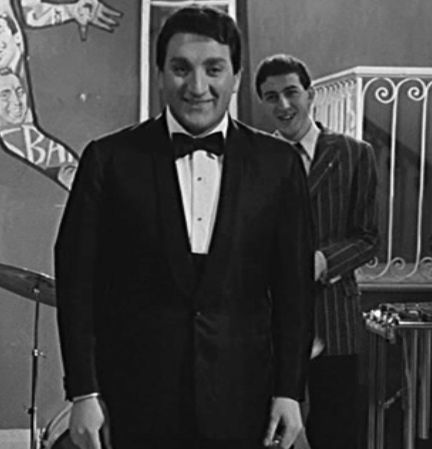
Tony Dallara, born Antonio Lardera on June 30, 1936, in Campobasso, Italy, is a name synonymous with the golden age of Italian music, particularly during the 1950s and 1960s. As the youngest of five children, Dallara was born into a musically inclined family. His father, Battista Lardera, was once a choir member at the prestigious La Scala in Milan, while his mother, Lucia, worked as a governess for a wealthy family in the same city.
Growing up in Milan, Dallara’s early life was typical of many young Italians of the time. After completing his mandatory education, he worked various jobs, including as a bartender and later as an office clerk. However, it wasn’t long before his passion for music overtook his interest in more traditional employment. He began singing with local groups, including one called the “Rocky Mountains,” which later changed its name to “I Campioni.” This group performed in various Milanese venues, gaining local popularity.
Rise to Fame
Tony Dallara’s musical influences were heavily shaped by American music, particularly by artists like Frankie Laine and Tony Williams of The Platters. His admiration for these artists was evident in his singing style, which he developed to echo the triplet-heavy rhythms and powerful vocals characteristic of American rock and roll and rhythm and blues.
His break came in 1957 when he was working as a messenger for the “Music” record label. The label’s boss, Walter Guertler, overheard Dallara singing and was immediately impressed by his vocal abilities. After attending one of Dallara’s performances at the Santa Tecla, a well-known Milanese nightclub, Guertler offered him a recording contract. It was at this point that Antonio Lardera was advised to adopt the stage name “Tony Dallara,” as his birth name was considered not particularly suited for the music industry.
Dallara’s first major hit was the song “Come prima,” which was released on a 45 RPM record in late 1957. The song, with lyrics written by Mario Panzeri, had been presented at the Sanremo Music Festival in 1955 but had not made it past the preliminary rounds. However, when Dallara recorded and released it, the song quickly climbed to the top of the Italian charts, staying there for several weeks. It sold over 300,000 copies, an extraordinary achievement for the time, and became one of the iconic pieces of Italian music from the 1950s.
The “Urlatori” Phenomenon
One of Tony Dallara’s most significant contributions to Italian music was his role in popularizing the “urlatori” (screamers) style of singing. This technique involved powerful, high-volume singing that was raw and stripped of the embellishments typical of traditional melodic Italian singing. The “urlatori” style was a marked departure from the established norms of the time, which were dominated by artists like Claudio Villa and Carlo Buti, who favored more classical, operatic vocal techniques.
Dallara’s style aligned more closely with the emerging trends in international music, particularly the influences of rock and roll, as seen in the work of contemporaries like Domenico Modugno and Adriano Celentano. This new style resonated with the younger generation, who were eager to embrace the more rebellious, energetic forms of music sweeping across the globe.
International Success
Tony Dallara’s talent soon caught the attention of international audiences. He was invited to perform at New York’s Carnegie Hall, one of the most prestigious venues in the world, and was even slated to do a show with Perry Como. However, his burgeoning international career was interrupted by his compulsory military service in Italy. During his time in the army, he met Franco Bracardi, a young pianist with whom he would form a lasting friendship.
Despite this setback, Dallara continued to release successful records throughout the late 1950s and early 1960s. Songs like “Ti dirò,” “Brivido blu,” “Ghiaccio bollente,” and “Julia” all became hits, further solidifying his status as one of Italy’s leading musical figures.
Movie Appearances and Sanremo Victories
In addition to his music career, Tony Dallara also ventured into the world of cinema. He appeared in two films in 1959: “Agosto, donne mie non vi conosco,” directed by Guido Malatesta, and “I ragazzi del juke-box,” directed by Lucio Fulci. These films featured other prominent Italian artists of the time, including Adriano Celentano and Fred Buscaglione.
Dallara’s success continued into the 1960s. He participated in the Sanremo Music Festival in 1960, partnering with Renato Rascel to win the competition with the song “Romantica.” This victory marked the peak of his career, as “Romantica” became one of the most beloved Italian songs of the era. He also appeared in additional films, including “Sanremo, la grande sfida” and “I Teddy Boys della Canzone,” further enhancing his fame.
In 1961, Dallara returned to Sanremo, this time performing alongside Gino Paoli with the song “Un uomo vivo.” While the song was well-received, it did not achieve the same level of success as “Romantica.” Nonetheless, Dallara continued to enjoy popularity and even won the “Canzonissima” competition with the song “Bambina, bambina.”
The Decline and Shift to Melodic Music
By the early 1960s, the tastes of the Italian public began to shift. The “beat” music phenomenon, which was influenced by the British invasion and the rise of rock bands like The Beatles, started to dominate the charts. In response to these changing trends, Tony Dallara tried to adapt his style, moving towards more melodic music. However, this shift did not bring him the same level of success that he had enjoyed in the late 1950s and early 1960s.
He attempted a comeback at Sanremo in 1964, performing the song “Come potrei dimenticarti” in collaboration with Ben E. King. Unfortunately, the song failed to reach the finals, marking the beginning of a period of decline in Dallara’s music career. Despite continuing to release new music throughout the 1960s, he was unable to regain his former chart-topping status. As a result, his presence on television and radio began to diminish.
A New Chapter: Painting and Artistic Pursuits
In the 1970s, Tony Dallara made a significant life change. He decided to step away from the music industry and pursue his passion for painting. Over the years, he had developed a deep interest in visual arts, and he began to focus on creating and exhibiting his work in various galleries. His talent as a painter was recognized by many, including the famous Italian painter Renato Guttuso, with whom Dallara formed a close friendship.
While Dallara may have left the music industry behind, his influence on Italian pop culture remained. His contributions to the “urlatori” style and his pioneering role in bringing a more modern, energetic sound to Italian music cannot be overstated.
The Revival of Tony Dallara
In the 1980s, Tony Dallara made a brief return to the music scene. This resurgence was largely fueled by a wave of nostalgia sweeping through Italy, as people began to rediscover and celebrate the music of previous decades. Dallara took advantage of this trend, performing live at various events and even re-recording some of his classic hits with modern arrangements. His performances were well-received, and he was able to enjoy a second wave of popularity, albeit on a smaller scale than during his peak years.
Throughout his career, Tony Dallara also showcased his linguistic versatility by recording songs in multiple languages, including Japanese, Spanish, German, Greek, French, and Turkish. His international appeal was evident, as he won awards and recognition in numerous countries around the world.
Legacy and Influence
Tony Dallara’s legacy in the world of Italian music is profound. He was a trailblazer who brought a new style and energy to the Italian music scene at a time when it was dominated by more traditional, melodic forms. His success paved the way for future generations of Italian artists who sought to experiment with different genres and vocal techniques.
Moreover, Dallara’s ability to cross cultural and linguistic barriers with his music highlights his unique talent and broad appeal. Even today, his songs are remembered and celebrated as part of Italy’s rich musical heritage.
Conclusion
Tony Dallara’s life and career are a testament to the power of innovation and the enduring appeal of music that resonates with the spirit of the times. From his humble beginnings in Milan to his rise as one of Italy’s most beloved singers, Dallara’s story is one of passion, creativity, and resilience. Although he faced challenges and periods of decline, his impact on Italian music remains undeniable, and his contributions continue to be celebrated by fans and musicians alike.


