
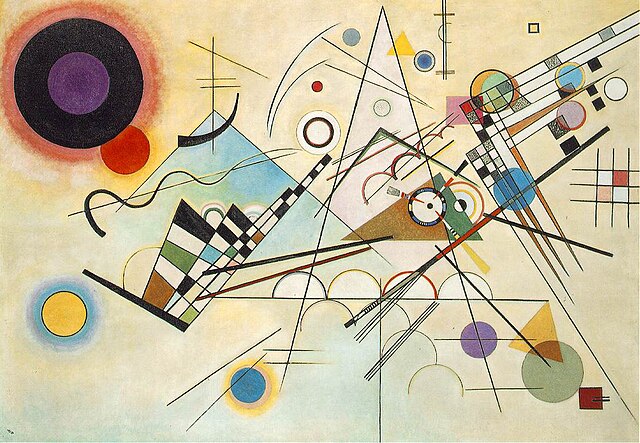
Vasilij Kandinskij, born on December 16, 1866, in Moscow, Russia, is widely regarded as one of the most influential pioneers of abstract art. His journey from a law student to a renowned painter and art theorist is a story of passion, innovation, and a relentless pursuit of creative freedom. Kandinskij’s work not only redefined the boundaries of visual art but also explored the deep connections between art, music, and spirituality.
Early Life and Education
Childhood and Family Background
Vasilij Kandinskij was born into a well-to-do bourgeois family in Moscow. His upbringing in a privileged environment provided him with access to a broad cultural education, which would later influence his artistic career. Despite his deep connection to Russian culture, Kandinskij’s early life was marked by a mix of influences from his family’s European connections, shaping his understanding of art and society.
Academic Pursuits
Initially, Kandinskij did not pursue art. He was steered towards a more traditional career path, studying law and economics at the University of Moscow. He excelled in his studies and was even offered a teaching position at the university upon graduation. However, Kandinskij’s true passion lay elsewhere. The turning point came when he attended an exhibition of French Impressionists in Moscow, where Claude Monet’s “Haystacks” left a profound impression on him. The abstract quality of the work, which seemed to transcend the conventional representation of reality, inspired Kandinskij to abandon his legal career and dedicate himself fully to painting.
The Musical Influence on Kandinskij’s Art
Early Artistic Development
Music played a pivotal role in Kandinskij’s artistic development. In his youth, he was trained in piano and cello, and this musical background deeply influenced his approach to visual art. Kandinskij believed that painting, like music, could evoke emotions and ideas without the need for concrete representation. This belief would become a cornerstone of his later work in abstract art.
Synesthesia and Art
Kandinskij experienced synesthesia, a condition where one sense triggers another—such as seeing colors when hearing music. This phenomenon profoundly impacted his work, leading him to create art that was deeply intertwined with musical composition. He often described his paintings in musical terms, such as calling certain works “compositions” or “improvisations.” This blending of sensory experiences was revolutionary, pushing the boundaries of what art could convey.
The Move to Munich and the Birth of Abstract Art
Relocation and Artistic Evolution
In 1896, Kandinskij moved to Munich, Germany, to pursue his artistic education more seriously. Munich, at the time, was a hub of artistic innovation and the birthplace of several avant-garde movements. Kandinskij quickly became involved in the vibrant artistic community, immersing himself in the latest developments in European art.
Founding of the Phalanx Group
In 1901, Kandinskij founded the Phalanx group, an association of artists dedicated to breaking away from traditional artistic conventions. This group organized exhibitions and art classes, promoting a new, more experimental approach to art. Kandinskij’s work during this period began to show the early signs of abstraction, as he moved away from representational art towards a more symbolic and expressive style.
The Blue Rider and the Emergence of Abstract Art
The Blue Rider Group
By 1911, Kandinskij had fully embraced abstract art, and he co-founded “Der Blaue Reiter” (The Blue Rider) with fellow artist Franz Marc. The group’s name was inspired by Kandinskij’s fascination with the color blue and Marc’s love of horses. The Blue Rider group was not just about creating art; it was about expressing a deeper, spiritual connection through their work. Kandinskij believed that art should reflect the inner world of the artist, rather than just the external reality.
Publication of “On the Spiritual in Art”
In 1910, Kandinskij published his seminal work, “On the Spiritual in Art,” which laid out his theories on abstract art. He argued that art should not merely imitate the physical world but should instead express the artist’s inner feelings and spiritual experiences. Kandinskij’s ideas were groundbreaking and challenged the conventional understanding of art at the time. His emphasis on the emotional and spiritual content of art helped pave the way for the development of modern abstract art.
Kandinskij’s Return to Russia and Later Career
World War I and Return to Russia
With the outbreak of World War I in 1914, Kandinskij returned to Russia. The post-revolutionary period in Russia was a time of significant change, and Kandinskij became actively involved in the new cultural movements. He helped to establish the Institute for Artistic Culture and played a key role in the development of the Russian avant-garde.
Contributions to Suprematism and Constructivism
During his time in Russia, Kandinskij was exposed to the emerging movements of Suprematism and Constructivism. Although his work remained distinct from these movements, he was influenced by their emphasis on geometric abstraction and their exploration of the relationship between art and society. Kandinskij’s work during this period became more structured, reflecting the broader trends in Russian avant-garde art.
The Bauhaus Years: A New Direction
Teaching at the Bauhaus
In 1921, Kandinskij returned to Germany, where he was invited by Walter Gropius to teach at the Bauhaus, an influential school of art, design, and architecture. The Bauhaus was a melting pot of ideas and innovation, and Kandinskij found himself in an environment that encouraged experimentation and collaboration. His time at the Bauhaus marked a new phase in his artistic career, as he continued to refine his abstract style.
Influence of Bauhaus on Kandinskij’s Work
The Bauhaus emphasized the integration of art and design, and this had a profound impact on Kandinskij’s work. His paintings became more geometric and precise, reflecting the Bauhaus’s focus on form and function. Kandinskij’s teaching at the Bauhaus also influenced a new generation of artists and designers, further solidifying his legacy as a pioneer of abstract art.
The Final Years in France
Move to Paris
After the Bauhaus was closed by the Nazi regime in 1933, Kandinskij moved to Paris. Although he was somewhat isolated from the main currents of modern art in France, Kandinskij continued to produce innovative work. His later paintings became more biomorphic, featuring organic shapes and vibrant colors, a departure from the geometric abstraction of his Bauhaus years.
Legacy and Death
Vasilij Kandinskij passed away on December 13, 1944, in Neuilly-sur-Seine, a suburb of Paris. His death marked the end of a remarkable career that had profoundly influenced the course of modern art. Kandinskij’s work had a lasting impact on a wide range of artistic movements, including Abstract Expressionism, which emerged in the United States after World War II.
The Significance of Kandinskij’s Work
The Birth of Abstract Art
Kandinskij is often credited with being the father of abstract art. His work broke away from the traditional representation of reality, focusing instead on the expression of inner emotions and spirituality. Kandinskij’s belief that art could be a powerful tool for personal and social transformation was revolutionary and continues to resonate with artists today.
Influence on Modern Art
Kandinskij’s influence extends far beyond his own work. His theories on color, form, and composition have become foundational principles in the study of modern art. Kandinskij’s emphasis on the spiritual and emotional aspects of art helped to shift the focus away from mere representation and towards a deeper exploration of the human experience.
Integration of Art and Music
One of Kandinskij’s most significant contributions to art was his exploration of the relationship between art and music. His synesthetic approach to painting, where colors and forms were inspired by musical compositions, opened up new possibilities for visual expression. This integration of art and music has had a lasting impact on various artistic disciplines, influencing everything from visual art to performance and multimedia installations.
Conclusion: Kandinskij’s Enduring Legacy
Vasilij Kandinskij’s legacy is one of innovation, creativity, and a relentless pursuit of artistic freedom. His work challenged the conventions of his time and laid the groundwork for the development of modern abstract art. Kandinskij’s exploration of the connections between art, music, and spirituality continues to inspire artists and thinkers across the globe.
As one of the most important figures in the history of modern art, Kandinskij’s influence is undeniable. His ability to transcend the boundaries of traditional art forms and create a new visual language has left an indelible mark on the world of art. Today, Kandinskij is celebrated not only as a pioneer of abstract art but also as a visionary who saw the potential for art to transform the way we see the world.


