
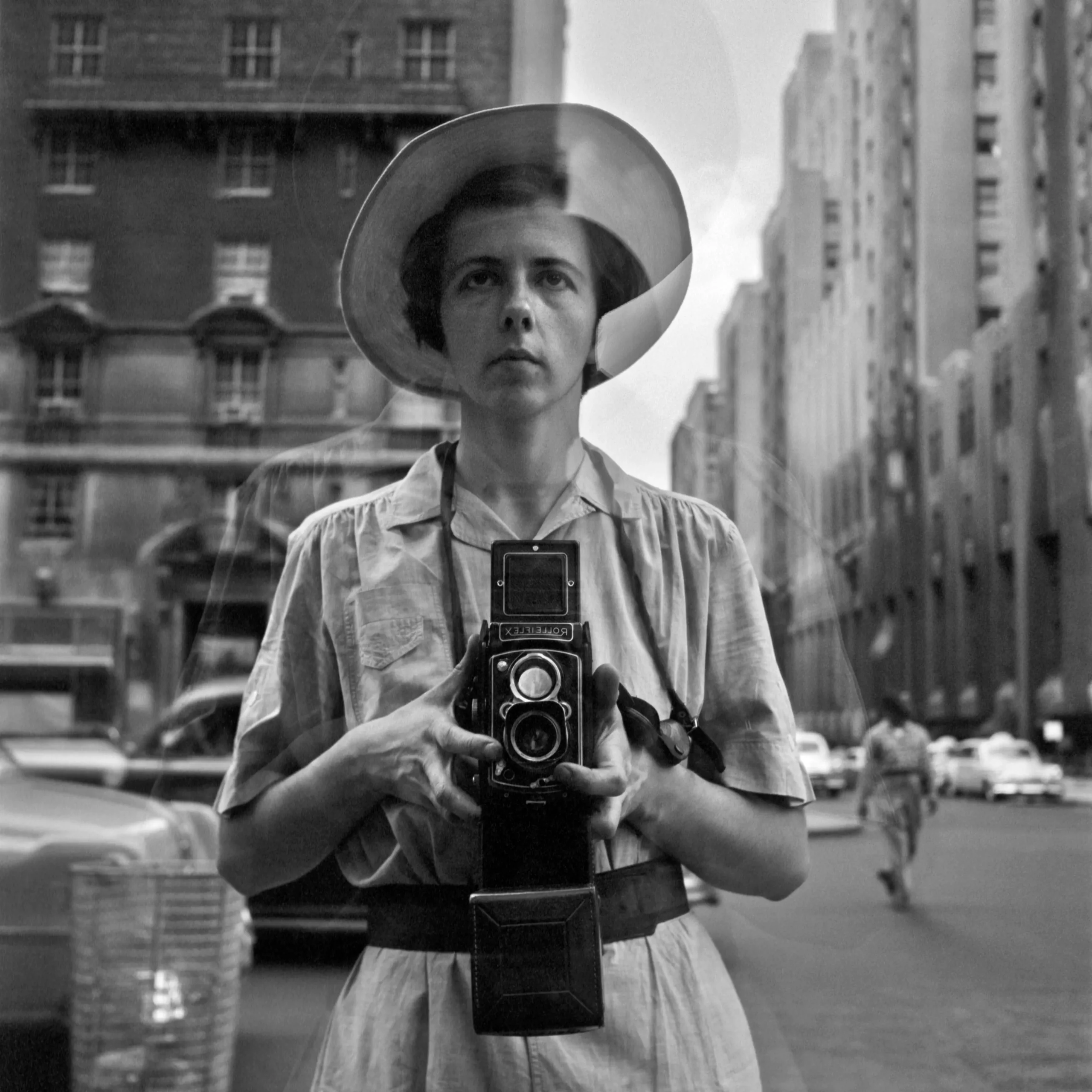
Vivian Maier, born on February 1, 1926, in New York City, is an iconic figure in the world of photography whose work remained unknown during her lifetime. It was only after her death in 2009 that her extraordinary talent as a street photographer came to light. Maier’s story is one of quiet dedication to her craft, capturing the everyday life of mid-20th century America with an eye for detail, composition, and human emotion. Her work now stands as a significant contribution to the history of photography, with her life story reflecting the enigmatic and solitary nature of her artistic journey.
Early Life and Background
Vivian Maier was born into a family with a rich cultural background—her father was of Austro-Hungarian descent, and her mother was French. Maier’s early years were marked by instability and separation, as her parents’ marriage was troubled, and she spent much of her childhood living with her mother in France. This early life experience, particularly the time spent with her mother and the photographer Jeanne Bertrand, who shared their apartment, likely had a profound impact on Maier’s later interest in photography.
Returning to New York in 1938, Maier began working as a nanny, a profession she would continue for the majority of her life. This role allowed her a certain degree of freedom and mobility, which she used to explore her passion for photography. While caring for children, Maier would often carry her camera with her, documenting the world around her with a keen and observant eye.
The Nanny Photographer
Vivian Maier’s life as a nanny was deeply intertwined with her photography. Her employers and the children she cared for were often unaware of the extent of her photographic activities. She would spend her days walking through the streets of Chicago and New York, capturing candid moments, street scenes, and portraits of ordinary people. Her work reflects a deep empathy for her subjects, many of whom were from the lower socio-economic classes, and a fascination with the urban environment.
Maier’s chosen tool was the Rolleiflex camera, a medium-format camera that allowed her to shoot from waist level. This perspective gave her photographs a unique angle and allowed her to photograph people without being intrusive. Her work from this period, primarily shot in black and white, reveals a world that is both intimate and expansive, filled with moments of humor, tenderness, and human connection.
Despite her prolific output, Maier kept her work private. She did not share her photographs with others, nor did she seek recognition for her talent. This decision to remain anonymous, coupled with her solitary lifestyle, has led many to view her as a mysterious figure, someone who created art not for fame or recognition, but out of a pure and personal need to capture the world around her.
The Discovery of a Hidden Talent
The story of Vivian Maier’s posthumous fame begins in 2007 when John Maloof, a young historian and real estate agent, purchased a box of her negatives at an auction for $380. Maloof was initially searching for historical photographs of Chicago for a book he was working on, but what he found was something far more valuable. The box contained thousands of negatives, undeveloped rolls of film, and prints that revealed the work of a highly skilled and observant photographer.
Maloof was struck by the quality of Maier’s work and began the painstaking process of developing the negatives and archiving her vast body of work, which eventually amounted to over 150,000 images. As he delved deeper into Maier’s life, he realized that he had stumbled upon one of the most significant discoveries in the history of photography.
Maloof’s efforts to bring Maier’s work to the public culminated in a series of exhibitions and the 2013 documentary Finding Vivian Maier, which he co-directed. The film, which was later nominated for an Academy Award, explores Maier’s life through her photographs, personal belongings, and interviews with the families she worked for. It paints a portrait of a complex, private individual who was both a caretaker and an artist, someone who saw the world with a unique and compassionate eye.
Vivian Maier’s Photographic Style and Themes
Vivian Maier’s photographic style is characterized by its immediacy, intimacy, and attention to detail. Her work is a study of contrasts—between light and shadow, wealth and poverty, joy and despair. She had a particular affinity for capturing the faces of the marginalized and the unnoticed, often photographing the elderly, children, and the working class with a sensitivity that reflects her deep empathy for her subjects.
One of the most striking aspects of Maier’s work is her use of self-portraiture. She frequently photographed herself in mirrors, reflections, and shadows, creating images that are both introspective and enigmatic. These self-portraits offer a glimpse into Maier’s identity as both the observer and the observed, blurring the line between artist and subject.
Maier’s work also includes a significant number of color photographs, particularly from the later years of her life. These images, taken with a Leica camera, showcase her ability to adapt to new technologies and her continued exploration of different photographic styles. Her color work, while less well-known than her black-and-white photography, is equally powerful, characterized by vibrant hues and a keen sense of composition.
The Impact of Maier’s Work on Photography
Vivian Maier’s work has had a profound impact on the field of photography, particularly in the genre of street photography. Her images, which capture the fleeting moments of everyday life, have been compared to the work of other great street photographers such as Henri Cartier-Bresson, Robert Frank, and Diane Arbus. However, Maier’s perspective is uniquely her own, shaped by her experiences as a woman, a nanny, and an outsider to the art world.
The rediscovery of Maier’s work has also sparked important conversations about the nature of art, authorship, and recognition. Maier’s story challenges traditional narratives about who gets to be remembered as an artist and how fame is constructed. Her posthumous fame, while bringing much-deserved attention to her work, also raises questions about the ethics of how her images have been used and who benefits from her legacy.
Maier’s influence can be seen in the work of contemporary photographers who continue to explore themes of anonymity, urban life, and the fleeting nature of human experience. Her photographs have been exhibited in galleries and museums around the world, and her story has inspired books, articles, and films that explore her life and work.
Later Life and Legacy
In the later years of her life, Vivian Maier faced significant financial difficulties. By the 1970s, she had transitioned to using a lighter, more portable camera and began shooting in color. However, she continued to live a life of relative obscurity, working as a nanny and taking photographs whenever she could. As she grew older, she became increasingly reclusive, eventually losing her job and facing eviction.
Maier’s health declined in the early 2000s, and she spent her final years in a nursing home in Chicago, supported by the Gensburg family, who had employed her for many years. She passed away on April 21, 2009, at the age of 83, without ever seeing her work recognized or celebrated.
Today, Vivian Maier is regarded as one of the most important photographers of the 20th century. Her work offers a unique window into the world of mid-century America, capturing the beauty, complexity, and diversity of urban life. Her photographs, which were once hidden away in boxes and storage units, are now celebrated as masterpieces of street photography, offering a testament to her talent, vision, and dedication to her craft.
Conclusion: The Enigmatic Legacy of Vivian Maier
Vivian Maier’s life and work are a fascinating study in contrasts—the anonymous nanny who became a world-renowned photographer, the private individual whose images are now public treasures. Her story is one of quiet perseverance, of an artist who created not for fame or recognition but out of a deep and abiding passion for capturing the world around her.
Maier’s legacy continues to grow as more of her work is discovered, developed, and shared with the world. Her photographs are a reminder of the power of art to transcend time, place, and circumstance, capturing the essence of human experience in a way that is both timeless and universal. As we continue to explore and celebrate her work, Vivian Maier stands as a symbol of the hidden potential within us all, a testament to the idea that greatness can be found in the most unexpected places.


