
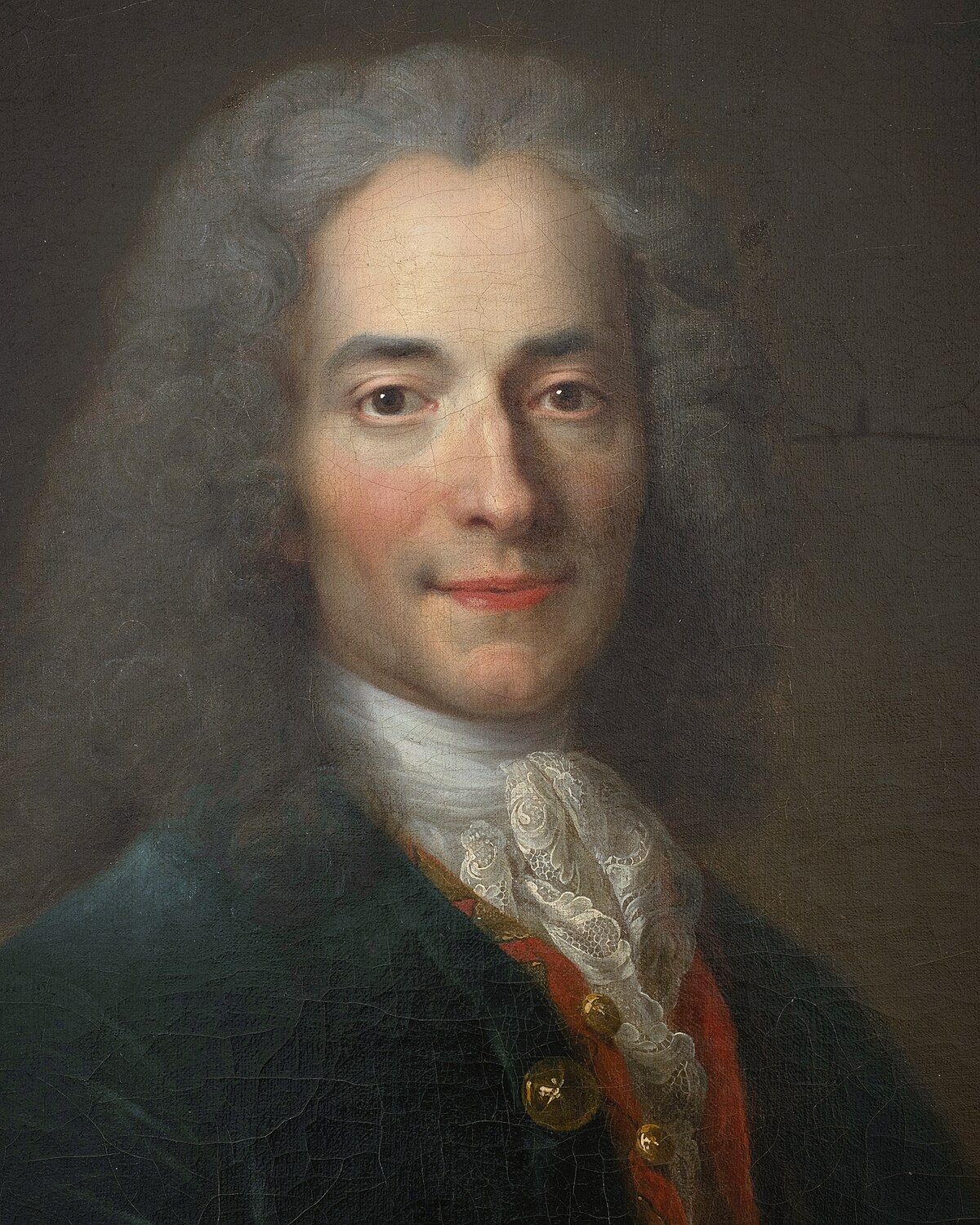
Voltaire, born François-Marie Arouet, was an influential Enlightenment thinker, whose life and work have left an indelible mark on history. Born on November 21, 1694, in Paris, Voltaire became one of the most celebrated writers, philosophers, and intellectuals of his time. His life was marked by his advocacy for civil liberties, his sharp wit, and his unyielding criticism of the institutions of his day, particularly the Church and the French monarchy.
Early Life and Education
Voltaire was born into a wealthy bourgeois family, which afforded him access to a solid education. He was educated by Jesuits at the prestigious Collège Louis-le-Grand in Paris, where he received a classical education that laid the foundation for his future intellectual pursuits. From a young age, Voltaire exhibited a sharp mind and a penchant for wit, traits that would define his career.
His early exposure to the liberal and libertine circles of Paris, particularly the Société du Temple, played a significant role in shaping his views. This society was known for its free-thinking members, and Voltaire quickly made a name for himself with his vibrant intellect and irreverent humor.
Early Career and Imprisonment
Voltaire’s early career was marked by his boldness and defiance of authority. In 1717, he was imprisoned in the Bastille for writing verses that were deemed insulting to the French Regent, Philippe II, Duke of Orléans. It was during this imprisonment that Voltaire adopted his famous pen name and began writing his first major works. His tragedy “Œdipe,” written during his time in the Bastille, was a success when it was staged in 1718, marking the beginning of his literary fame.
However, Voltaire’s outspokenness would continue to get him into trouble. A dispute with the powerful Chevalier de Rohan in 1726 resulted in Voltaire being exiled to England. This exile proved to be a formative experience for Voltaire, as his exposure to the English political system, philosophy, and society deeply influenced his thinking.
Influence of English Ideas
During his three-year stay in England, Voltaire became enamored with the ideas of constitutional monarchy, the separation of powers, and the freedoms of speech and religion. He was particularly influenced by the works of John Locke and the ideas of the British Enlightenment. These experiences culminated in his “Lettres philosophiques” (or “Letters on the English Nation”), published in 1733. These letters, which praised the English system of government and criticized French institutions, were considered scandalous in France, leading to their condemnation and the threat of arrest for Voltaire.
Literary Achievements and Philosophical Works
Voltaire’s literary output was prodigious, spanning a wide range of genres including plays, poetry, novels, essays, and historical writings. His works were characterized by their wit, satire, and a clear advocacy for civil liberties and social reform.
One of his early successes was the epic poem “La Henriade,” which celebrated the life of Henry IV of France and advocated for religious tolerance. Voltaire’s historical writings, such as “The Age of Louis XIV” and the “Essay on the Manners and Spirit of Nations,” were groundbreaking in their secular approach to history, focusing on cultural and social developments rather than purely political events.
Voltaire is perhaps best known for his philosophical works, particularly the novella “Candide,” published in 1759. “Candide” is a biting satire that criticizes the optimistic philosophy of Leibniz and the idea that “all is for the best in the best of all possible worlds.” The work remains one of the most widely read and studied pieces of literature from the Enlightenment period.
Conflict with the Church and Advocacy for Civil Rights
Voltaire’s relationship with the Catholic Church was contentious. He was a vocal critic of the Church’s power and its role in suppressing freedom of thought. His famous rallying cry, “Écrasez l’infâme” (“Crush the infamous thing”), referred to the abuses of the Church and other institutions of power.
Voltaire’s advocacy for civil rights extended beyond his writings. He was involved in several high-profile cases where he fought against injustice, such as the Calas affair. In this case, Voltaire defended a Protestant family wrongly accused of murdering their son to prevent his conversion to Catholicism. His efforts in this case, and others like it, helped to bring about greater awareness of the need for legal reform and religious tolerance.
Later Life and Legacy
In the latter part of his life, Voltaire became increasingly wealthy and influential. He settled in the Château de Ferney near the French-Swiss border in 1758, where he spent the last 20 years of his life. Ferney became a hub of intellectual activity, attracting visitors from all over Europe who came to seek Voltaire’s counsel and discuss ideas.
Voltaire continued to write prolifically during this period, producing works that furthered his advocacy for reason, tolerance, and reform. His “Treatise on Tolerance” (1763) and “Philosophical Dictionary” (1764) are among his most important later works, in which he calls for the triumph of reason over superstition and prejudice.
Voltaire returned to Paris in 1778, where he was celebrated as a hero of the Enlightenment. However, his return was short-lived, as he died on May 30, 1778. Despite his death, Voltaire’s influence continued to grow. His remains were buried in secret, as he was denied a Christian burial, but during the French Revolution, his body was exhumed and reburied in the Panthéon in Paris, where he remains a symbol of the fight for freedom and reason.
Historical Context and Impact
Voltaire lived during a time of great change in Europe. The Enlightenment was a period characterized by the rise of scientific thinking, secularism, and a challenge to traditional authority. Voltaire was at the forefront of this intellectual movement, and his works reflect the values of the Enlightenment: reason, skepticism, and a belief in progress.
His criticisms of the Church and the state were part of a broader critique of the ancien régime, the old order of France. Voltaire’s ideas helped to lay the groundwork for the French Revolution, although he did not live to see it. His writings on civil liberties and social reform continue to resonate today, influencing modern concepts of human rights and freedom of speech.
Voltaire’s legacy is vast, not only in the realm of literature but also in the broader context of Western thought. His commitment to reason, his fearless criticism of power, and his advocacy for justice have made him a lasting figure in history. Today, Voltaire is remembered not only as a great writer but also as a champion of the values that underpin modern democratic societies.
SEO Considerations and Keyword Strategy
When writing about Voltaire for an audience that may be searching for information on this Enlightenment figure, it is important to consider keyword density and search intent. Relevant keywords might include “Voltaire biography,” “Enlightenment thinker,” “Candide,” “French Revolution,” and “civil liberties.” The use of these keywords should be natural and integrated into the text in a way that enhances readability and relevance.
Additionally, it is important to provide detailed insights and explanations that go beyond basic biographical information. By exploring the nuances of Voltaire’s life, his philosophical beliefs, and his impact on history, the content becomes more valuable to readers, which can improve its ranking in search results.
In conclusion, Voltaire’s life is a testament to the power of ideas and the enduring importance of the fight for freedom and justice. His work continues to inspire and challenge readers, making him a central figure in the history of Western thought.


