
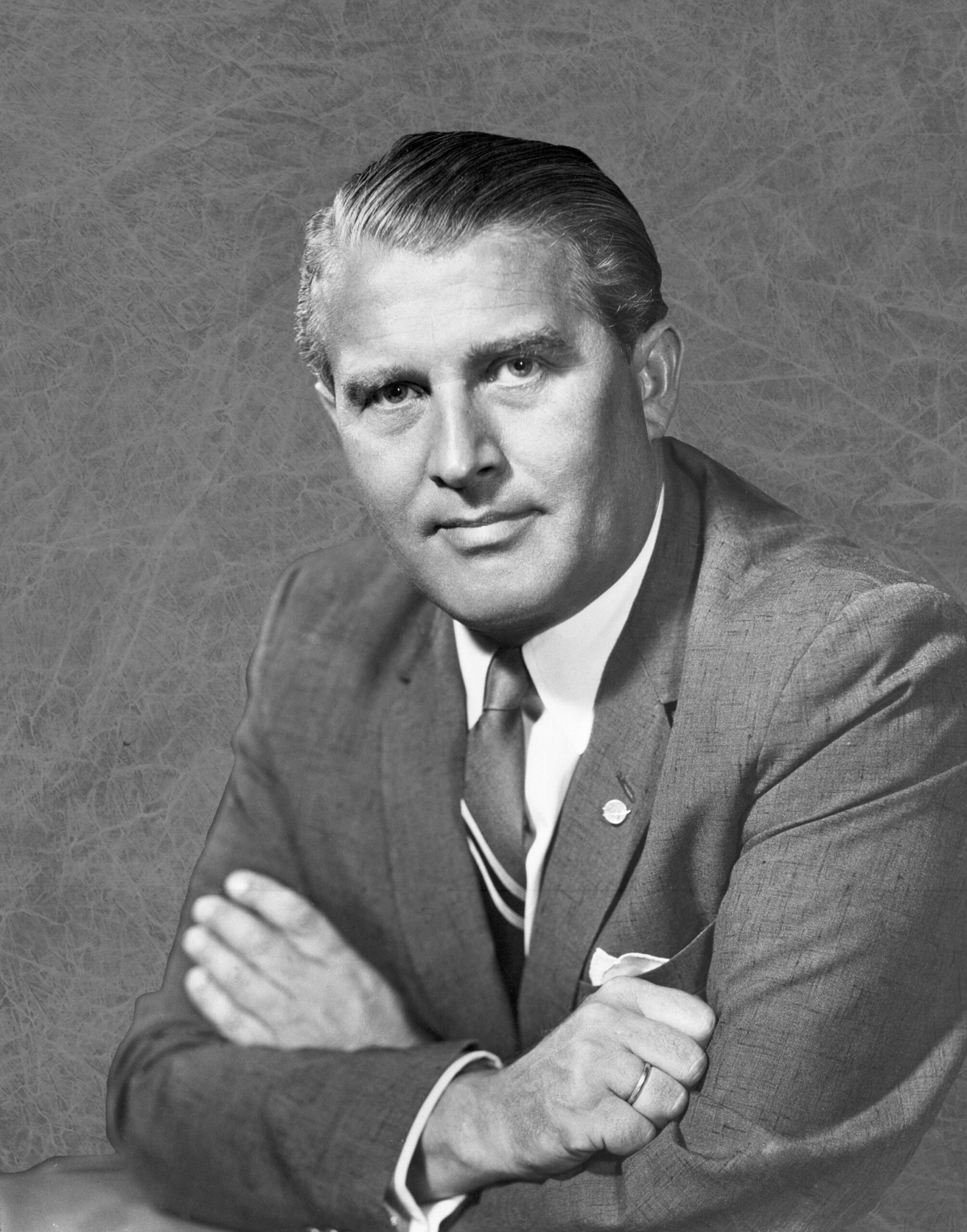
Wernher von Braun, a name synonymous with the dawn of the space age, is one of the most influential figures in the history of rocketry and space exploration. Born on March 23, 1912, in Wirsitz, Posen, Prussia (now Wyrzysk, Poland), von Braun’s life was marked by extraordinary achievements and controversies that continue to provoke debate today. As the father of modern rocketry, his contributions to space technology were instrumental in launching humanity into the cosmos. This article delves into the life, achievements, and legacy of Wernher von Braun, providing detailed insights into his journey from Nazi Germany to the United States, where he became a pivotal figure in the American space program.
Early Life and Education
Wernher von Braun was born into an aristocratic family with a strong tradition of public service. His father, Magnus von Braun, was a high-ranking government official, and his mother, Emmy von Quistorp, was a descendant of European nobility. Growing up in a privileged environment, von Braun was exposed to science and technology at an early age, which sparked his fascination with rocketry and space exploration.
As a child, von Braun’s interest in science was piqued by a book he received as a gift, Die Rakete zu den Planetenräumen (“The Rocket into Interplanetary Space”) by Hermann Oberth, a pioneer of rocketry. This book ignited von Braun’s passion for space and set him on a path that would define his life’s work. He became an avid reader of science fiction and devoured the works of Jules Verne and H.G. Wells, which fueled his imagination and dreams of space travel.
Von Braun’s formal education began at the Hermann-Lietz-Internat, an elite boarding school where he excelled in mathematics and physics. He later attended the Technical University of Berlin, where he studied under Professor Hermann Oberth, who became a mentor to the young von Braun. Under Oberth’s guidance, von Braun participated in the construction and launch of experimental rockets, laying the groundwork for his future career in rocketry.
Rise to Fame in Nazi Germany
Wernher von Braun’s rise to prominence began in the early 1930s when he joined the German Society for Space Travel (VfR), a group dedicated to advancing the science of rocketry. His talent quickly caught the attention of the German military, which was interested in developing long-range rockets as weapons. In 1932, von Braun was recruited by the German Army to work on rocket development, marking the beginning of his involvement with the Nazi regime.
Von Braun’s work during World War II is one of the most controversial aspects of his life. As the technical director of the German rocket program, he led the development of the V-2 rocket, the world’s first long-range guided ballistic missile. The V-2 was a formidable weapon, capable of delivering a 1,000-kilogram warhead over a distance of 320 kilometers. It was used by the Nazis to bomb London and other Allied cities, causing significant casualties and destruction.
The V-2 rocket was a technological marvel, but its development came at a terrible human cost. The rockets were produced at the Mittelwerk facility, where thousands of forced laborers, including concentration camp inmates, were subjected to inhumane conditions. Many died from overwork, malnutrition, and abuse. Von Braun’s involvement with the Nazi regime and the use of forced labor in the production of the V-2 rockets have raised ethical questions that continue to overshadow his legacy.
Despite these controversies, von Braun’s technical achievements during the war were undeniable. The V-2 rocket represented a significant advancement in rocket technology and laid the foundation for the development of modern space launch vehicles. After the war, von Braun and his team of scientists were captured by the Allies as part of Operation Paperclip, a secret program to recruit German scientists to work for the United States.
Transition to the United States and the Space Race
Wernher von Braun’s transition to the United States marked a new chapter in his life and career. In 1945, he and his team were brought to the U.S. as part of Operation Paperclip, where they began working for the U.S. Army on ballistic missile technology. Von Braun’s expertise in rocketry was invaluable to the U.S. military, and he quickly became a key figure in the development of the Redstone missile, which would later be used to launch the first American satellite, Explorer 1, into orbit.
Von Braun’s work with the U.S. Army laid the groundwork for the American space program, but it was his leadership at NASA that solidified his place in history. In 1960, von Braun became the director of NASA’s Marshall Space Flight Center, where he led the development of the Saturn V rocket, the vehicle that would ultimately take humans to the moon.
The Saturn V rocket is one of von Braun’s most significant achievements. Standing 363 feet tall and capable of generating 7.5 million pounds of thrust, the Saturn V remains the most powerful rocket ever built. It was the backbone of NASA’s Apollo program, which culminated in the historic Apollo 11 mission, when astronauts Neil Armstrong and Buzz Aldrin became the first humans to set foot on the moon on July 20, 1969.
Von Braun’s role in the Apollo program was pivotal. His leadership and vision were instrumental in overcoming the technical challenges of building a rocket capable of carrying astronauts to the moon and back. The success of the Apollo missions cemented von Braun’s reputation as one of the greatest engineers of the 20th century and a pioneer of space exploration.
Personal Life and Ethical Controversies
Wernher von Braun’s personal life was marked by contrasts, reflecting the complexities of his character. He married Maria von Quistorp in 1947, and the couple had three children. Despite his public persona as a brilliant scientist and engineer, von Braun was a deeply private individual who rarely spoke about his past or his involvement with the Nazi regime.
The ethical controversies surrounding von Braun’s work during World War II continue to be a subject of debate. While his contributions to space exploration are widely celebrated, his involvement in the development of the V-2 rocket and the use of forced labor in its production have led to questions about his moral responsibility.
Von Braun himself acknowledged the ethical dilemmas of his work in Nazi Germany, but he often portrayed himself as a scientist who was more interested in advancing rocket technology than in the political or military implications of his work. In interviews, he emphasized that his primary goal was always space exploration, and he viewed his work on military rockets as a necessary step toward achieving that goal.
However, critics argue that von Braun’s complicity in the Nazi war effort cannot be overlooked. His willingness to work for a regime that committed atrocities on a massive scale has led some to view him as a morally compromised figure. The debate over von Braun’s legacy reflects broader questions about the responsibilities of scientists and engineers in times of war and the ethical implications of their work.
Legacy and Impact on Space Exploration
Wernher von Braun’s legacy is a complex one, shaped by both his remarkable achievements in space exploration and the ethical controversies of his past. His contributions to the American space program were unparalleled, and his work laid the foundation for many of the advances in space technology that we take for granted today.
One of von Braun’s most enduring legacies is his role in the Apollo program, which remains one of humanity’s greatest achievements. The successful landing of astronauts on the moon was a testament to von Braun’s vision, leadership, and technical expertise. The Saturn V rocket, which he designed, is still considered one of the greatest engineering feats of all time.
Von Braun’s influence extended beyond the Apollo program. His advocacy for space exploration helped to shape public policy and inspired a generation of scientists and engineers. He was a passionate advocate for space travel, often speaking about the potential of space exploration to benefit humanity and advance our understanding of the universe.
In addition to his technical achievements, von Braun was also a prolific writer and communicator. He authored numerous articles and books on space exploration, and he played a key role in popularizing the idea of human spaceflight. His vision of space exploration as a peaceful and cooperative endeavor continues to resonate with people around the world.
However, von Braun’s legacy is also marked by the ethical questions surrounding his work during World War II. The use of forced labor in the production of the V-2 rockets and his association with the Nazi regime have led to ongoing debates about his moral responsibility. These controversies serve as a reminder of the complex and often troubling intersections between science, technology, and politics.
Historical Context and Influence on Modern Space Programs
To fully understand Wernher von Braun’s impact, it’s essential to consider the historical context in which he lived and worked. The 20th century was a period of rapid technological advancement, driven in large part by the geopolitical tensions of the Cold War. The space race between the United States and the Soviet Union was a central element of this conflict, and von Braun’s work was at the heart of America’s efforts to win the race to the moon.
The success of the Apollo program was not only a triumph of engineering but also a powerful symbol of American technological superiority. Von Braun’s role in this achievement cannot be overstated. His ability to bring together a team of scientists and engineers, his strategic vision, and his technical expertise were all critical to the success of the program.
Von Braun’s influence on modern space programs is still evident today. The rockets and spacecraft used by NASA and other space agencies around the world are direct descendants of the technologies that von Braun helped to develop. His work laid the foundation for the International Space Station, Mars exploration missions, and the development of commercial spaceflight.
In recent years, private companies like SpaceX have built on von Braun’s legacy, using similar principles and technologies to advance the goals of space exploration. The dream of human space travel, which von Braun championed throughout his life, is now closer to becoming a reality than ever before.
Conclusion
Wernher von Braun was a visionary engineer whose work transformed the field of space exploration and left an indelible mark on history. From his early days as a rocket scientist in Nazi Germany to his role as the architect of the American space program, von Braun’s life was marked by extraordinary achievements and complex ethical questions.
His contributions to the development of rocket technology and the success of the Apollo program are undeniable. The Saturn V rocket, which he designed, remains one of the most significant engineering accomplishments in human history, and the Apollo missions stand as a testament to what can be achieved when science and technology are harnessed for the pursuit of knowledge and exploration.
However, von Braun’s legacy is also a reminder of the moral dilemmas that can arise when science is used for military purposes. His involvement with the Nazi regime and the use of forced labor in the production of the V-2 rockets continue to provoke debate and reflection.
In the end, Wernher von Braun’s life and work offer a nuanced and complex portrait of a man who was both a brilliant scientist and a figure of controversy. His achievements in space exploration have inspired generations, but his legacy also serves as a cautionary tale about the ethical responsibilities of scientists and engineers in the pursuit of technological advancement.


