
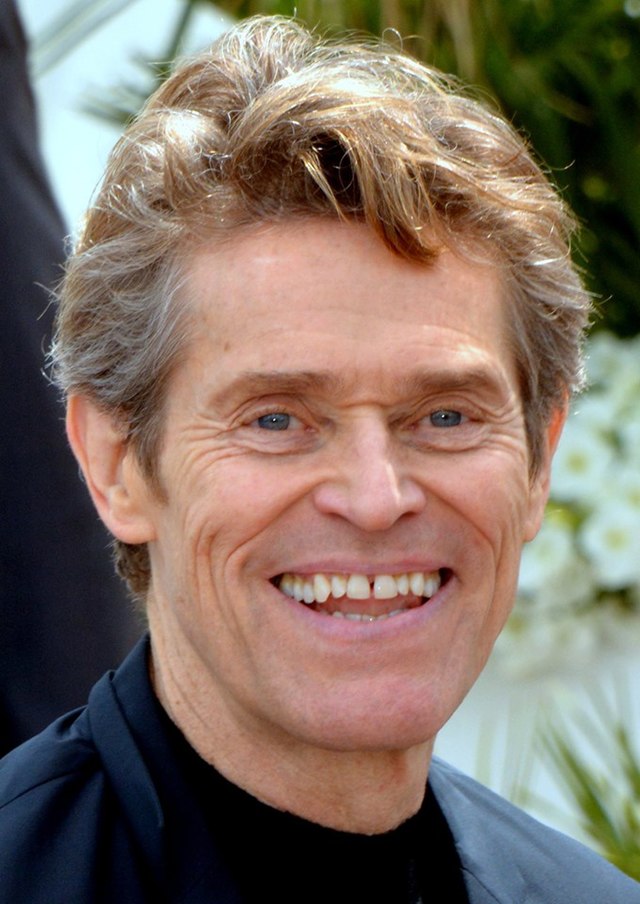
Willem Dafoe, born on July 22, 1955, in Appleton, Wisconsin, has carved out a unique and enduring career in Hollywood. Known for his distinctive features and extraordinary versatility, Dafoe has become one of the most respected and enigmatic actors in the industry. His journey from a small-town boy in Wisconsin to an internationally acclaimed actor is a testament to his talent, resilience, and unwavering commitment to his craft. This article explores the life, fame, and significant highlights of Willem Dafoe’s career, offering a detailed insight into the man behind some of cinema’s most memorable roles.
Early Life and the Road to Acting
William James Dafoe, known professionally as Willem Dafoe, grew up in a large family as the seventh of eight children. His upbringing in Appleton, Wisconsin, was far from the glamorous world he would eventually inhabit. His interest in the arts was evident from a young age, but his early path to acting was anything but conventional.
Dafoe’s first brush with controversy came during his school years when he was suspended for making an explicit film. This incident, which took place at Einstein Junior High School, highlighted his rebellious nature and his desire to push boundaries—traits that would later define his acting career. Despite this setback, Dafoe’s passion for performance never waned.
He initially enrolled at the University of Wisconsin, but the traditional academic route didn’t suit him. Instead, he found his true calling in the theater. Dafoe joined the experimental Theatre X in Milwaukee, where he honed his craft through avant-garde performances that took him across the United States and Europe.
By 1977, Dafoe had relocated to New York City, where he became a founding member of the influential Wooster Group, an experimental theater collective. His work with the Wooster Group solidified his reputation as a daring and committed performer, unafraid to tackle challenging and often controversial material. It was during this time that he met Elizabeth LeCompte, the group’s artistic director, who would become his longtime partner and the mother of his son, Jack.
Breakthrough in Film: From Supporting Roles to Stardom
Willem Dafoe’s transition from theater to film came in 1980 with a minor role in Michael Cimino’s epic “Heaven’s Gate.” Although the film was a notorious box-office failure, it marked the beginning of Dafoe’s journey in Hollywood. His breakthrough role came six years later in Oliver Stone’s Vietnam War drama “Platoon” (1986), where he played the compassionate and conflicted Sergeant Elias. The role earned him his first Academy Award nomination for Best Supporting Actor and established him as a serious talent in the film industry.
Dafoe’s performance in “Platoon” was a pivotal moment in his career. The film’s success and critical acclaim propelled him into the spotlight, allowing him to secure a variety of roles that showcased his range as an actor. From mainstream blockbusters to independent films, Dafoe proved himself to be an incredibly versatile performer.
Versatility and Iconic Roles
One of Willem Dafoe’s most remarkable qualities as an actor is his ability to seamlessly transition between vastly different roles. Whether portraying villains, heroes, or complex characters, Dafoe brings a depth and intensity to every performance.
In 1988, Dafoe took on one of the most controversial roles of his career, playing Jesus in Martin Scorsese’s “The Last Temptation of Christ.” The film, which explored the human aspects of Jesus’ life, sparked outrage and protests, particularly from religious groups. Despite the controversy, Dafoe’s portrayal was widely praised for its sensitivity and depth, further solidifying his reputation as a fearless actor willing to take on challenging and provocative roles.
Throughout the 1990s and early 2000s, Dafoe continued to build an impressive filmography. He played a diverse array of characters, from the sadistic Bobby Peru in David Lynch’s “Wild at Heart” (1990) to the enigmatic Max Schreck in “Shadow of the Vampire” (2000), a role that earned him his second Academy Award nomination for Best Supporting Actor.
Dafoe’s versatility is perhaps best exemplified by his ability to move effortlessly between big-budget Hollywood productions and independent films. In the 2002 film “Spider-Man,” he portrayed the Green Goblin, the arch-nemesis of the titular superhero. His performance as the twisted and tormented villain brought him widespread recognition and introduced him to a new generation of moviegoers.
However, Dafoe never allowed himself to be pigeonholed as a mainstream actor. He continued to work on more experimental projects, collaborating with directors like Lars von Trier in “Antichrist” (2009) and Abel Ferrara in “Pasolini” (2014), where he played the iconic Italian filmmaker and writer Pier Paolo Pasolini.
Commitment to Craft: Dafoe’s Approach to Acting
Willem Dafoe’s approach to acting is deeply rooted in his early theater experiences. His time with the Wooster Group instilled in him a sense of discipline and a commitment to the creative process. Dafoe is known for immersing himself completely in his roles, often going to great lengths to embody the characters he portrays.
This dedication to his craft is evident in the way he prepares for each role. Dafoe often conducts extensive research, delving into the psychological and emotional aspects of his characters. Whether it’s learning a new skill, undergoing physical transformations, or exploring complex emotional states, Dafoe’s commitment to authenticity sets him apart as an actor.
His willingness to take on physically and emotionally demanding roles has earned him a reputation as one of the most dedicated actors in the industry. For example, in Lars von Trier’s “Antichrist,” Dafoe not only performed many of his own stunts but also engaged in intense, often disturbing scenes that required immense psychological resilience.
The 2010s and Continued Success
As Willem Dafoe entered his sixties, his career showed no signs of slowing down. The 2010s were marked by a series of critically acclaimed performances that reinforced his status as one of Hollywood’s most respected actors.
In 2017, Dafoe starred in “The Florida Project,” a film that received widespread praise for its portrayal of life on the fringes of society. Dafoe’s performance as Bobby, the manager of a budget motel, was hailed as one of the best of his career. His nuanced portrayal of a man trying to maintain order in a chaotic environment earned him his third Academy Award nomination for Best Supporting Actor.
The following year, Dafoe took on the role of Vincent van Gogh in Julian Schnabel’s biographical drama “At Eternity’s Gate” (2018). His portrayal of the tortured artist was widely acclaimed, earning him his fourth Academy Award nomination, this time for Best Actor. Dafoe’s performance was praised for its emotional depth and sensitivity, capturing the essence of van Gogh’s genius and suffering.
In addition to his work in film, Dafoe continued to explore new creative avenues. He lent his distinctive voice to several animated films, including “Finding Nemo” (2003) and “The Simpsons Movie” (2007), further showcasing his versatility as a performer.
Personal Life and Private Persona
Despite his fame, Willem Dafoe has managed to maintain a relatively private personal life. He is known for being intensely private, rarely making headlines for anything other than his work. Dafoe has been in a long-term relationship with director Elizabeth LeCompte, with whom he has a son, Jack. The couple has kept their relationship largely out of the public eye, focusing instead on their respective careers and creative pursuits.
Dafoe’s aversion to the trappings of fame is well-documented. He has often spoken about his preference for a simple, unpretentious lifestyle, far removed from the glitz and glamour of Hollywood. When not working, Dafoe enjoys spending time on his farm, where he engages in manual labor and enjoys the peace and quiet of rural life.
This grounded approach to life has allowed Dafoe to remain focused on his craft, free from the distractions that often accompany fame. His dedication to his work and his ability to maintain a sense of normalcy have endeared him to both fans and colleagues alike.
Legacy and Influence
Willem Dafoe’s impact on the film industry is undeniable. Over the course of his four-decade-long career, he has delivered some of the most memorable performances in cinema history. His ability to embody a wide range of characters, from villains to heroes, from real-life figures to fantastical creations, has made him one of the most versatile actors of his generation.
Dafoe’s influence extends beyond his performances. He has worked with some of the most visionary directors in the industry, contributing to films that have pushed the boundaries of storytelling and cinematic expression. His willingness to take on challenging and unconventional roles has inspired a new generation of actors to embrace risk and creativity in their own careers.
As Willem Dafoe continues to work on new projects, his legacy as an actor and a creative force in the film industry is assured. He remains a powerful presence on screen, a master of his craft, and a true artist dedicated to the pursuit of excellence.
Conclusion: The Enduring Appeal of Willem Dafoe
Willem Dafoe’s career is a testament to the power of versatility, dedication, and an unwavering commitment to artistic integrity. From his early days in experimental theater to his rise as a Hollywood icon, Dafoe has consistently challenged himself and his audiences, delivering performances that resonate long after the credits roll.
As he continues to explore new roles and push the boundaries of his craft, Willem Dafoe remains one of the most compelling actors of our time. His work is a reminder of the transformative power of cinema and the enduring appeal of an artist who refuses to be confined by convention.


