
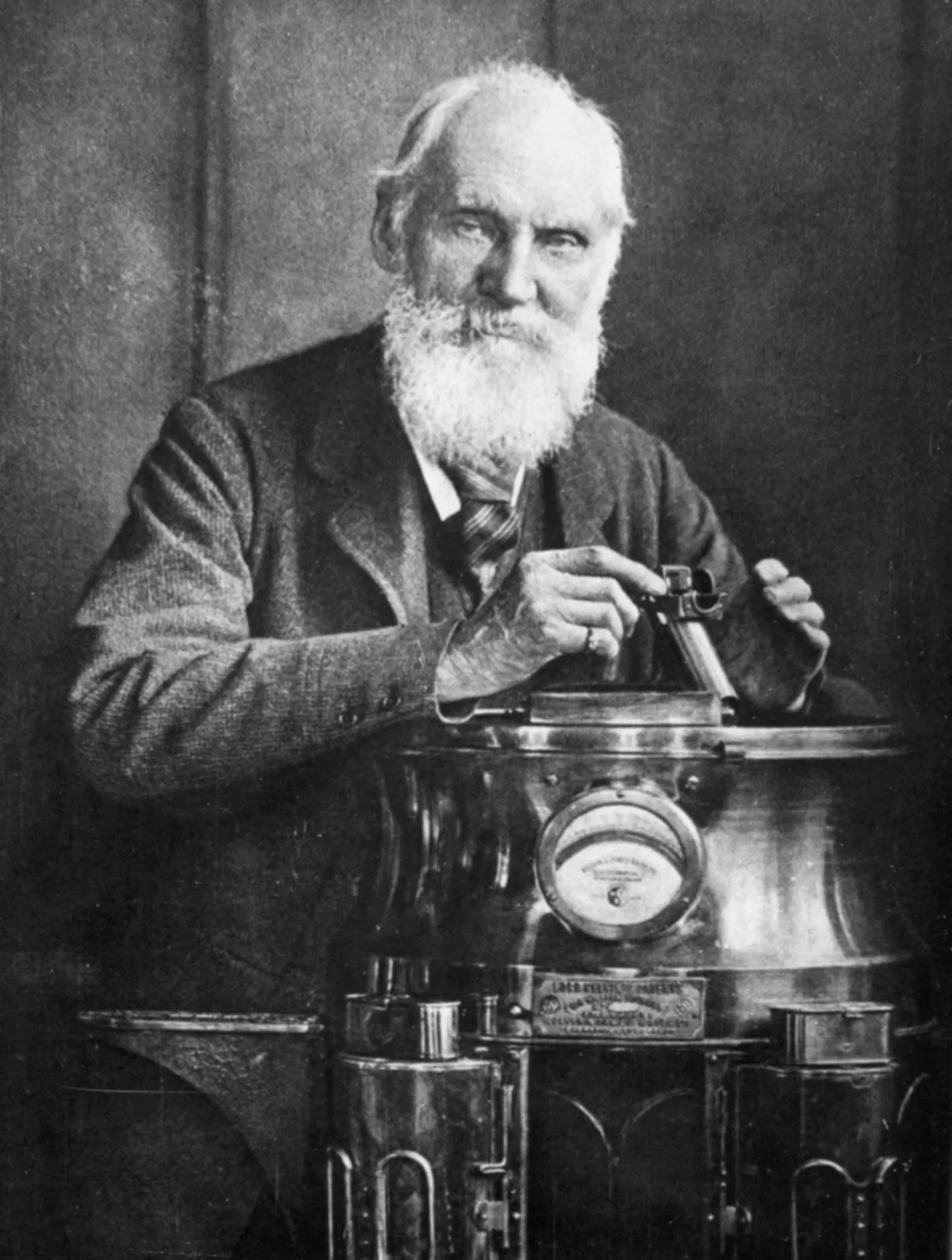
Early Life and Education
William Thomson, more famously known as Lord Kelvin, was born on June 26, 1824, in Belfast, Ireland. He was the second of four children in a family that valued education and intellectual achievement. His father, James Thomson, was a mathematics professor, which had a significant influence on William’s early development. When William was only six years old, his mother passed away, prompting the family to move to Glasgow, Scotland, where his father had been appointed as a professor at the University of Glasgow.
Thomson was a prodigious talent from a young age, particularly in mathematics. At just 10 years old, he began attending the University of Glasgow, where he quickly distinguished himself as a gifted student. By the age of 17, Thomson was ready to further his studies at the prestigious University of Cambridge, where he would lay the groundwork for his future contributions to science.
Academic Career and Early Achievements
After graduating from Cambridge in 1845, Thomson spent some time in Paris, where he worked with Henri-Victor Regnault, a prominent physicist. During this period, Thomson expanded his knowledge and refined his skills in scientific experimentation and mathematical analysis. His early academic career was marked by numerous publications, with his first scientific paper being published when he was just 16 years old.
In 1846, at the remarkably young age of 22, Thomson was appointed Professor of Natural Philosophy at the University of Glasgow, a position he held for over half a century. It was here that Thomson began to make his most significant contributions to the fields of physics and engineering.
Contributions to Thermodynamics
One of Thomson’s most enduring contributions to science is his work in thermodynamics. In 1847, he proposed the concept of an absolute temperature scale, which would later become known as the Kelvin scale. This was a revolutionary idea that provided a fundamental understanding of temperature and energy, laying the groundwork for the development of modern thermodynamics.
Thomson’s work on the Kelvin scale was closely linked to his collaboration with James Prescott Joule, an English physicist. Together, they formulated the Joule-Thomson effect, which describes how a gas cools as it expands without doing work. This principle is still applied today in various technologies, including refrigeration and air conditioning systems.
In 1851, Thomson published a pivotal paper outlining the second law of thermodynamics, which states that heat naturally flows from a hotter body to a cooler one and that this process is irreversible. This work further established Thomson’s reputation as one of the leading scientists of his time and cemented his legacy in the field of physics.
Engineering and Inventions
In addition to his theoretical work, Thomson was also an accomplished engineer and inventor. His involvement in the transatlantic telegraph project is one of the most notable examples of his engineering prowess. In the mid-19th century, laying a telegraph cable across the Atlantic Ocean was a monumental challenge, fraught with technical difficulties. Thomson played a crucial role in the success of this project by developing new techniques and instruments to improve the efficiency and reliability of the telegraph system.
One of Thomson’s key inventions during this time was the mirror galvanometer, a sensitive device used to detect and measure weak electrical signals. This invention was instrumental in the successful completion of the transatlantic telegraph cable, as it allowed for the accurate transmission of messages over long distances. Thomson’s contributions to this project were so significant that in 1866, he was knighted for his efforts, becoming Sir William Thomson.
Thomson’s inventive spirit did not stop with the telegraph. He went on to obtain more than 70 patents over his lifetime, covering a wide range of technologies, from electrical measurement devices to improvements in shipbuilding and navigation. His work in these areas had a lasting impact on both science and industry, further solidifying his reputation as a leading innovator of his time.
The Title of Lord Kelvin and Later Life
In recognition of his contributions to science and engineering, William Thomson was elevated to the peerage in 1892, becoming Baron Kelvin of Largs. The title “Kelvin” was chosen in reference to the River Kelvin, which flows near the University of Glasgow, where Thomson spent much of his academic career.
As Lord Kelvin, Thomson continued to be an active and influential figure in the scientific community. He served as the President of the Royal Society from 1890 to 1895, where he played a key role in promoting scientific research and education. Despite his many achievements, Thomson remained humble and dedicated to his work, often spending long hours in his laboratory, even in his later years.
Scientific Legacy and Controversies
While Lord Kelvin made numerous groundbreaking contributions to science, his later years were marked by a certain resistance to some of the new scientific ideas emerging at the time. One of the most notable examples of this was his opposition to Darwin’s theory of evolution by natural selection. Kelvin’s calculations of the Earth’s age, based on its cooling rate, suggested that the planet was much younger than the timescales required for Darwin’s theory. However, Kelvin’s estimates did not account for the heat generated by radioactive decay, a factor that was not well understood at the time.
Similarly, Kelvin was skeptical of the emerging theories in physics, such as the theory of relativity and quantum mechanics, which began to challenge the classical physics framework that he had helped to build. Despite these controversies, Kelvin’s contributions to science remained foundational, and his work continued to influence future generations of scientists.
Influence on Modern Science and Technology
Lord Kelvin’s work laid the foundation for many of the technological advancements that followed in the 20th century. His contributions to thermodynamics and electromagnetism, in particular, have had a lasting impact on fields ranging from engineering to environmental science.
The Kelvin scale remains a fundamental tool in the physical sciences, used in everything from cryogenics to astrophysics. The principles of thermodynamics that Kelvin helped to establish continue to be central to our understanding of energy, entropy, and the laws of nature.
Kelvin’s legacy also extends to the world of engineering, where his inventions and innovations have had a lasting influence. The mirror galvanometer, for example, is an early precursor to many modern electrical measuring devices, and his work on the transatlantic telegraph paved the way for the global communications networks that we rely on today.
Personal Life and Character
William Thomson was known not only for his intellectual achievements but also for his character. He was a deeply religious man, and his faith played a significant role in shaping his worldview. He believed that science and religion were not in conflict but rather complementary ways of understanding the universe. This belief influenced his approach to scientific inquiry, which was always marked by a deep sense of curiosity and a desire to uncover the fundamental truths of nature.
Thomson was also a man of great humility and kindness. Despite his many honors and accolades, he remained approachable and willing to share his knowledge with others. He was a mentor to many young scientists and engineers, and his influence can be seen in the work of those who followed in his footsteps.
Conclusion
William Thomson, Lord Kelvin, was a towering figure in the history of science, whose contributions to thermodynamics, electromagnetism, and engineering have left an indelible mark on the world. His work laid the foundation for many of the technological advancements that have shaped the modern era, and his influence continues to be felt in fields ranging from physics to environmental science.
Despite his resistance to some of the new scientific ideas that emerged in his later years, Kelvin’s legacy remains one of innovation, curiosity, and a relentless pursuit of knowledge. His life and work serve as a reminder of the power of science to transform our understanding of the world and to drive progress in ways that benefit all of humanity.
Lord Kelvin’s story is one of a brilliant mind dedicated to uncovering the mysteries of the universe, a legacy that will continue to inspire future generations of scientists, engineers, and thinkers.


