
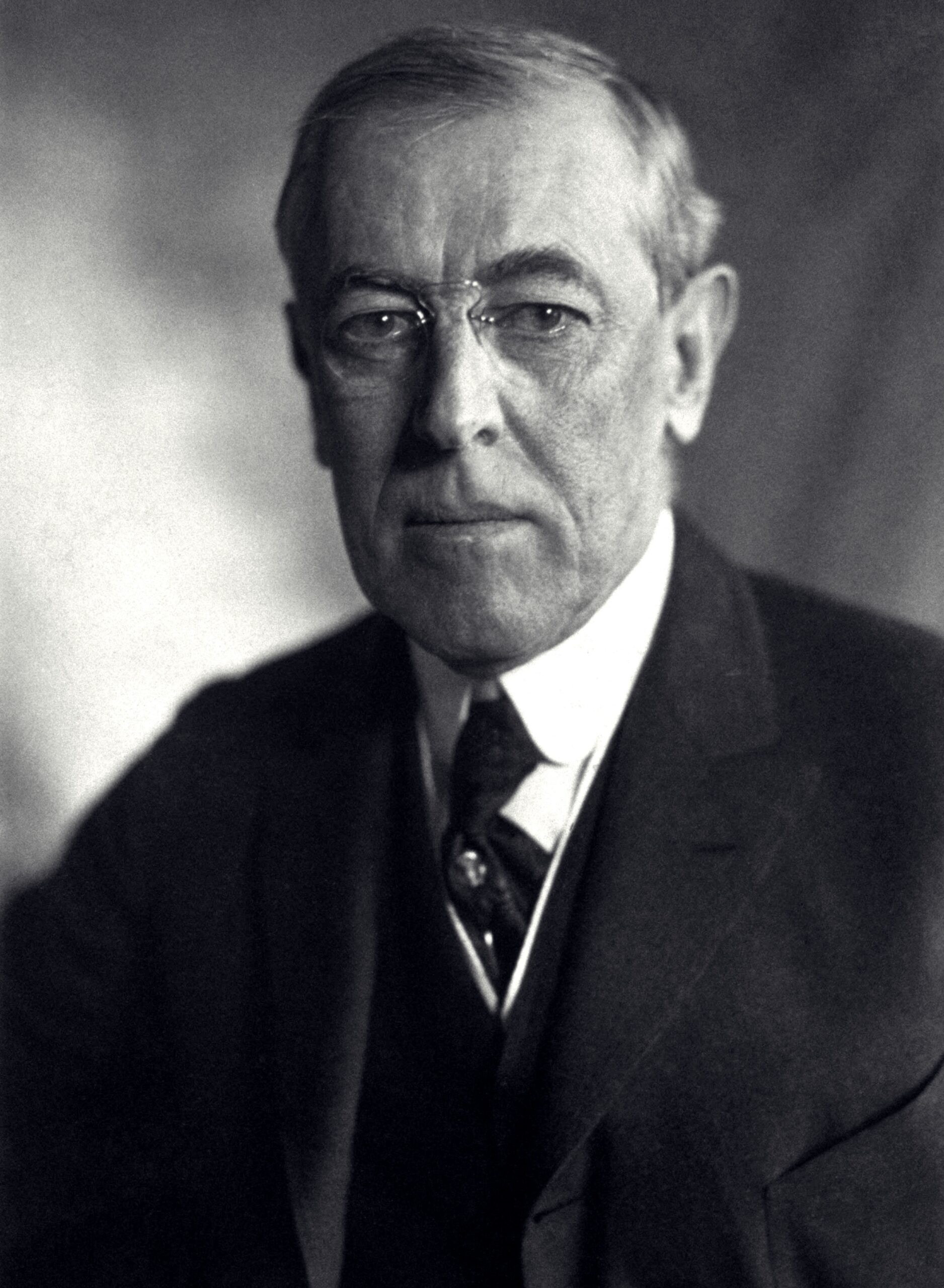
Woodrow Wilson, the 28th President of the United States, is a pivotal figure in American history, celebrated for his contributions to both domestic policy and international relations. Born on December 28, 1856, in Staunton, Virginia, Thomas Woodrow Wilson emerged from a background rooted in the South during a period of great transformation in the United States. His life and presidency are marked by significant achievements and controversies, making him a complex and fascinating figure to study.
Early Life and Education
Wilson’s early life was shaped by the turbulent period of the American Civil War and Reconstruction. His father, a Presbyterian minister, and his family moved frequently across the South during his childhood. This experience provided Wilson with a unique perspective on the political and social dynamics of the time. Despite struggles with dyslexia, he was an avid reader and developed a keen interest in history and government from an early age.
Wilson pursued higher education with a determination that would define his later career. He attended Princeton University, where he distinguished himself as a serious student with a strong interest in government and political theory. After graduating in 1879, he briefly studied law at the University of Virginia but soon realized that his true passion lay in academia. Wilson went on to earn a Ph.D. in political science from Johns Hopkins University, making him the only U.S. president to hold a doctorate.
Academic Career and Rise to Prominence
Before entering politics, Wilson enjoyed a successful academic career. He taught at several universities, including Bryn Mawr College and Wesleyan University, before returning to Princeton as a professor of political science. His scholarly work, particularly his writings on government and constitutional theory, earned him a reputation as a leading intellectual of his time.
Wilson’s academic success culminated in his appointment as President of Princeton University in 1902. During his tenure, he implemented significant reforms aimed at modernizing the university’s curriculum and expanding its reach. His leadership at Princeton brought him national attention and set the stage for his entry into politics.
Governorship of New Jersey
In 1910, Wilson entered the political arena as the Democratic candidate for Governor of New Jersey. His campaign focused on progressive reforms, including efforts to combat corruption and monopolistic practices, which were rampant in the state. His platform resonated with voters, and he won the election by a wide margin.
As governor, Wilson enacted a series of progressive policies that brought him national acclaim. He targeted the influence of powerful corporations, implemented labor reforms, and promoted social justice initiatives. His success in New Jersey established him as a leading figure in the progressive movement and positioned him for a run at the presidency.
The 1912 Presidential Election and First Term
Wilson’s rise to the presidency in 1912 was a result of a split within the Republican Party between incumbent President William Howard Taft and former President Theodore Roosevelt, who ran as a third-party candidate. This division allowed Wilson, as the Democratic nominee, to secure the presidency with a platform centered on progressive reform, known as the “New Freedom.”
During his first term, Wilson pursued an ambitious agenda that included the reduction of tariffs, the establishment of the Federal Reserve System, and the implementation of antitrust legislation. His domestic policies were aimed at curbing the power of large corporations, protecting workers’ rights, and promoting fair competition. These efforts solidified his reputation as a reformer and earned him widespread support.
World War I and International Leadership
Wilson’s second term in office was dominated by the outbreak of World War I. Initially, he sought to keep the United States neutral, a stance that resonated with many Americans. However, as the war progressed, and particularly after the sinking of the Lusitania and the revelation of the Zimmermann Telegram, Wilson was compelled to take a more active role.
In April 1917, Wilson asked Congress to declare war on Germany, marking the United States’ entry into World War I. His decision was driven by a desire to make the world “safe for democracy” and to shape the post-war international order.
Wilson’s vision for the post-war world was articulated in his famous “Fourteen Points” speech, delivered in January 1918. This plan outlined principles for peace, including self-determination for nations, free trade, and the establishment of the League of Nations—a precursor to the United Nations. Wilson’s commitment to these ideals earned him the Nobel Peace Prize in 1919.
The Treaty of Versailles and Domestic Opposition
Wilson played a leading role in the negotiations at the Paris Peace Conference, which resulted in the Treaty of Versailles. The treaty imposed harsh penalties on Germany and redrew the map of Europe, but it also established the League of Nations, which Wilson saw as his greatest achievement.
However, his triumph on the international stage was met with fierce opposition at home. The U.S. Senate, driven by isolationist sentiment and concerns about entangling alliances, refused to ratify the Treaty of Versailles or join the League of Nations. This defeat was a significant blow to Wilson, both personally and politically.
Final Years and Legacy
Wilson’s final years in office were marred by declining health. In 1919, he suffered a severe stroke that left him partially paralyzed. Despite his incapacitation, he remained in office until the end of his term in 1921, relying heavily on his wife, Edith Wilson, who effectively managed many aspects of his presidency during this period.
After leaving office, Wilson lived in relative seclusion in Washington, D.C., where he passed away on February 3, 1924. His legacy, however, continues to be a subject of debate among historians. While he is praised for his progressive reforms and leadership during World War I, his administration’s record on civil rights is often criticized. Wilson’s policies toward African Americans, including his support for segregation in federal offices, have tarnished his reputation in the eyes of many.
Conclusion: Woodrow Wilson’s Impact on American History
Woodrow Wilson’s life and presidency left a lasting impact on the United States and the world. His efforts to reform American society and his leadership during one of the most tumultuous periods in global history have secured his place in the annals of American history. However, his legacy is complex, reflecting both the achievements and the contradictions of his time.
Wilson’s vision for a world governed by principles of democracy and self-determination, as outlined in his Fourteen Points, continues to resonate today. Yet, his failures, particularly in the realm of race relations and his inability to secure U.S. participation in the League of Nations, serve as reminders of the limitations of even the most visionary leaders.
As we reflect on Wilson’s life, it is essential to consider both his accomplishments and his shortcomings. His presidency offers valuable lessons on the challenges of leadership, the complexities of governance, and the enduring struggle to balance ideals with practical realities.
In summary, Woodrow Wilson was a man of profound intellect and ambition, whose influence on American and global history is undeniable. His legacy, marked by both triumph and tragedy, continues to inspire and challenge us to this day.


