
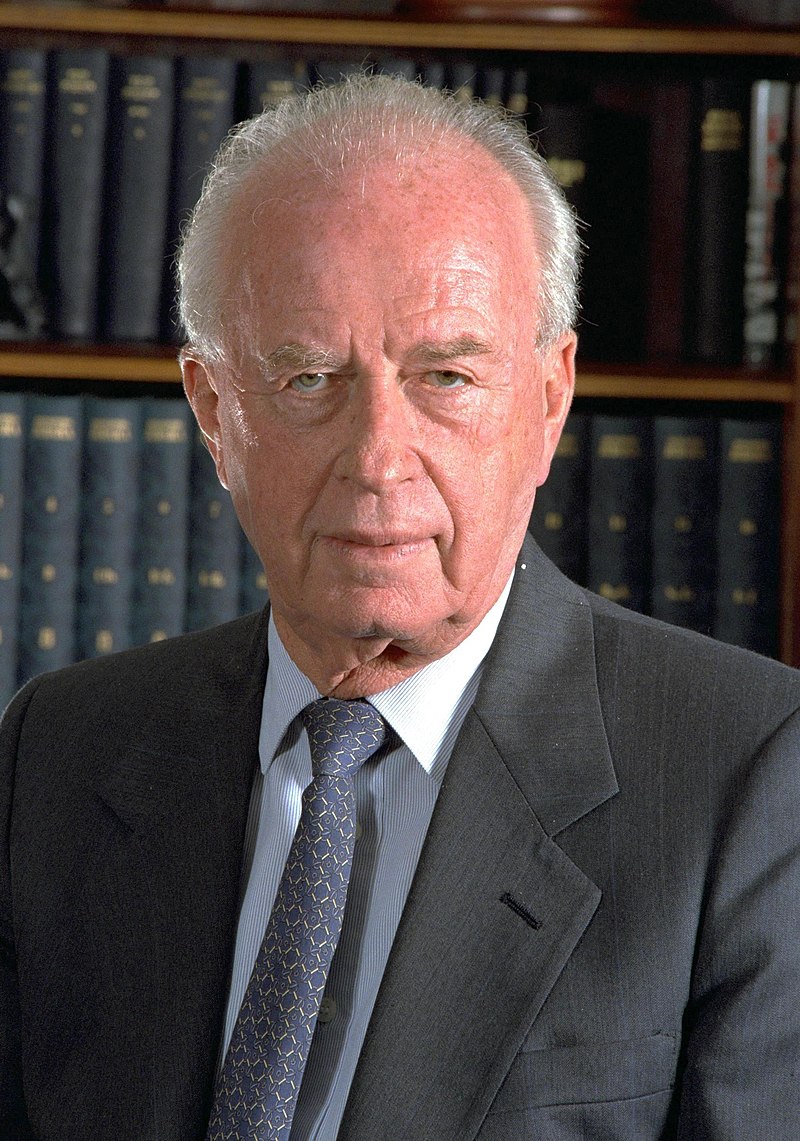
Yitzhak Rabin, one of the most influential figures in the history of Israel, was born in Jerusalem on March 1, 1922. He became the first Prime Minister of Israel who was born on the soil of what would become the State of Israel. Rabin’s life is a tale of military valor, diplomatic achievements, and a relentless pursuit of peace, a pursuit that ultimately cost him his life.
Early Life and Military Career
Born into a fervent Zionist family, Rabin’s early years were shaped by the tumultuous environment of pre-state Israel. He received his education at the prestigious Kadoorie Agricultural High School, where he developed a deep connection with the land and an understanding of the importance of agriculture in the Zionist project.
In the 1940s, Rabin joined the Palmach, an elite unit of the Haganah, the underground military organization of the Jewish community in Palestine. His leadership qualities quickly became evident, and he rose through the ranks. During the 1948 Arab-Israeli War, Rabin played a pivotal role in the defense of Jerusalem and later in various other military operations. His experience in the Palmach laid the foundation for his long and illustrious military career.
Rise to Military Prominence
Rabin’s military career reached new heights in the 1960s. By 1964, he had been appointed Chief of Staff of the Israel Defense Forces (IDF), the highest-ranking position in the Israeli military. Under his command, the IDF achieved a stunning victory in the Six-Day War of 1967, where Israel decisively defeated the armies of Egypt, Jordan, and Syria. This victory not only cemented Rabin’s reputation as a brilliant military strategist but also made him a national hero.
Diplomatic and Political Career
After retiring from the military in 1968, Rabin transitioned into a diplomatic role, serving as Israel’s ambassador to the United States. During his tenure, he worked tirelessly to strengthen the relationship between Israel and the United States, laying the groundwork for what would become a crucial alliance in the coming decades.
Rabin entered the political arena in 1973, joining the Labor Party and being elected to the Knesset, Israel’s parliament. His political acumen was soon recognized, and in 1974, following the resignation of Prime Minister Golda Meir, Rabin was chosen as her successor, becoming the fifth Prime Minister of Israel.
First Term as Prime Minister
Rabin’s first term as Prime Minister (1974-1977) was marked by significant challenges both domestically and internationally. Domestically, Rabin focused on rebuilding public trust in the government following the traumatic Yom Kippur War. He also initiated economic reforms and sought to address social disparities within Israeli society.
On the international front, Rabin pursued a pragmatic approach to peace and security. In 1975, he signed an interim agreement with Egypt, which laid the groundwork for the eventual peace treaty between the two nations. Rabin also oversaw the successful Entebbe raid in 1976, a daring rescue mission in Uganda that freed Israeli hostages held by Palestinian and German terrorists.
However, Rabin’s first term was cut short in 1977 when a financial scandal involving his wife forced him to resign. The scandal, related to a foreign bank account held by Leah Rabin, was a violation of Israeli law at the time. Despite this setback, Rabin remained a significant figure in Israeli politics.
Defense Minister and Return to Power
For the next several years, Rabin served as Israel’s Minister of Defense in various governments. During this period, he managed the complex security situation in Lebanon and played a key role in suppressing the First Intifada, a Palestinian uprising against Israeli rule in the occupied territories.
Rabin’s tenure as Defense Minister was marked by his belief in a strong military response to security threats while also recognizing the need for a political solution to the Israeli-Palestinian conflict. This dual approach would later define his second term as Prime Minister.
Second Term as Prime Minister and the Pursuit of Peace
In 1992, Rabin made a political comeback, leading the Labor Party to victory in the general elections and once again becoming Prime Minister. His second term was arguably the most significant period of his political career, as he shifted his focus towards achieving peace with Israel’s neighbors.
Rabin’s most notable achievement during this period was the signing of the Oslo Accords in 1993. The Oslo Accords, negotiated secretly in Norway, were a historic agreement between Israel and the Palestine Liberation Organization (PLO), represented by Yasser Arafat. The accords marked the first time that Israel officially recognized the PLO as the representative of the Palestinian people, and they established a framework for resolving the Israeli-Palestinian conflict.
The signing ceremony, held on the White House lawn and witnessed by U.S. President Bill Clinton, was a moment of immense significance. Rabin’s handshake with Arafat symbolized a hopeful step towards peace after decades of conflict. For his efforts, Rabin was awarded the Nobel Peace Prize in 1994, along with Arafat and Israeli Foreign Minister Shimon Peres.
Rabin’s peace efforts extended beyond the Palestinian issue. In 1994, he signed a peace treaty with Jordan, normalizing relations between the two countries and further stabilizing the region. These efforts were part of Rabin’s broader vision of a secure Israel living in peace with its neighbors.
Assassination and Legacy
Tragically, Rabin’s pursuit of peace made him a target for extremists. On November 4, 1995, during a peace rally in Tel Aviv, Rabin was assassinated by Yigal Amir, a right-wing Israeli extremist opposed to the Oslo Accords. Rabin’s assassination was a profound shock to Israel and the world, marking the first time an Israeli Prime Minister had been assassinated.
Rabin’s legacy is one of a leader who combined military strength with a deep commitment to peace. His life’s work was dedicated to securing Israel’s future, both through military might and diplomatic negotiations. Today, Rabin is remembered as a symbol of the complex and often painful pursuit of peace in the Middle East.
Historical Context and Significance
To fully understand Yitzhak Rabin’s impact, it is essential to consider the historical context in which he operated. Rabin’s life spanned a period of intense transformation for Israel and the broader Middle East. From the early days of the Yishuv (the Jewish community in Palestine) to the establishment of the State of Israel and the subsequent decades of conflict and negotiation, Rabin was a central figure.
His military achievements, particularly during the Six-Day War, ensured Israel’s survival in a hostile region. However, it was his later recognition that military victories alone could not secure Israel’s future that defined his lasting legacy. Rabin’s willingness to engage with the Palestinians and other Arab nations demonstrated a pragmatic understanding of the need for compromise in pursuit of lasting peace.
The Oslo Accords, despite their limitations and the subsequent breakdown of the peace process, represented a significant shift in Israeli policy. Rabin’s assassination highlighted the deep divisions within Israeli society and the challenges that any leader faces in navigating the complex and often contradictory demands of security, peace, and national identity.
Conclusion
Yitzhak Rabin remains a towering figure in Israeli history. His life was a testament to the challenges and complexities of leadership in a nation constantly at the crossroads of war and peace. Rabin’s legacy continues to influence Israeli politics and the broader Middle East peace process. As Israel and its neighbors continue to grapple with the same issues that defined Rabin’s career, his vision of peace through strength and negotiation remains as relevant as ever.
In the end, Yitzhak Rabin’s story is not just one of a soldier and a statesman, but of a man who, despite the odds, sought to turn the dream of peace into a reality. His life and legacy serve as a reminder of the enduring importance of leadership, courage, and the relentless pursuit of peace.


